
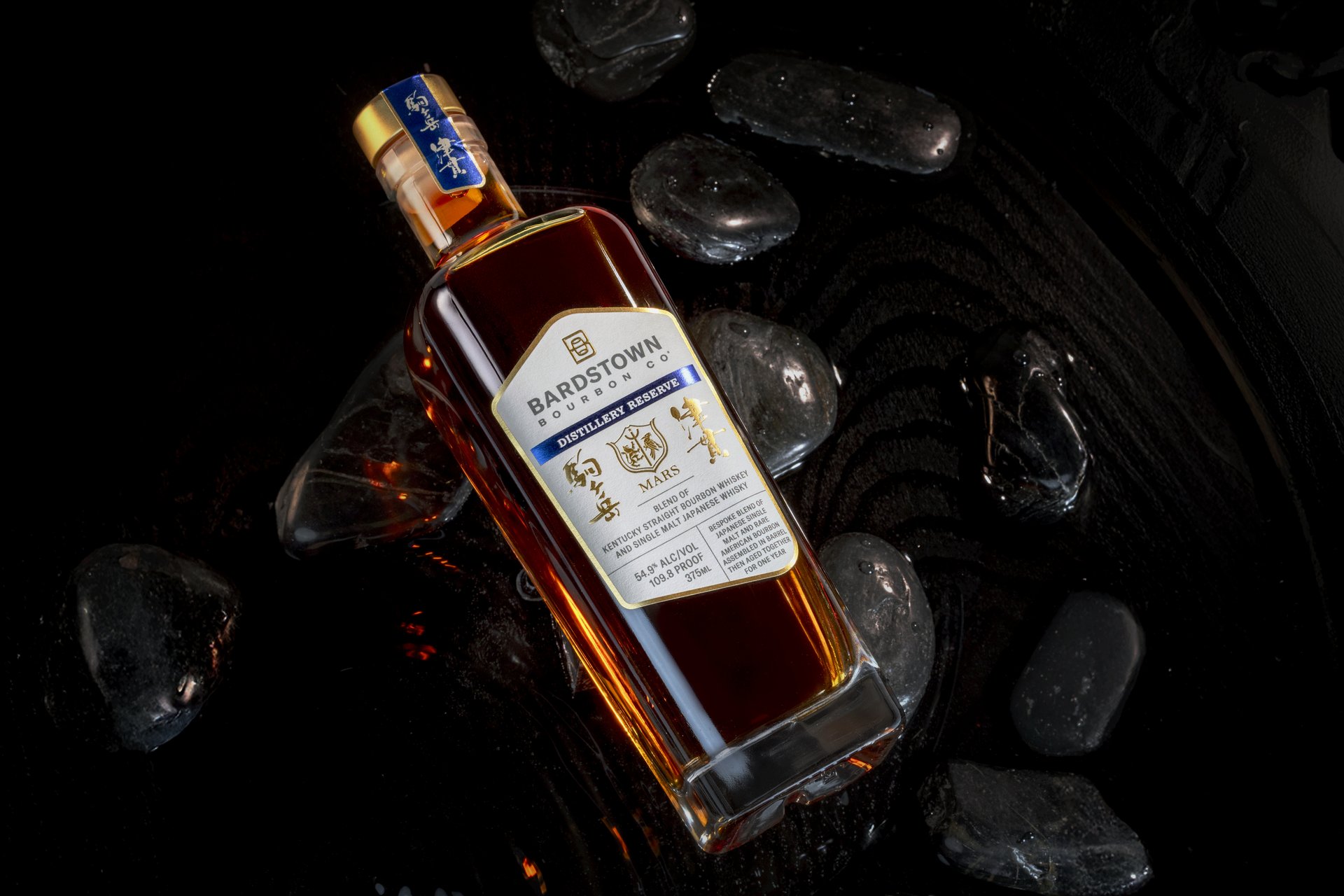
Bardstown Bourbon Company is doing something a little different with the angels' share this year. Instead of letting the empty space in a barrel just be empty, they've been filling it with Japanese single malt — and letting the two whiskies age together for a full year before bottling.
The latest Distillery Reserve, called Mars Single Malt Japanese Blend, drops May 29 in extremely limited quantities. It's the first time we've seen a Kentucky bourbon producer actually co-age with Japanese whisky in the same barrel rather than just finish in a used cask. The collaboration is with Japan's Mars distilleries — both Komagatake in central Honshu and Tsunuki down south in Kagoshima — and the work was done in Bardstown.
How it was put together
Mars shipped over two single malts, both 100% malted barley with very different finishing histories before they left Japan:
- Komagatake single malt — aged in Umeshu (plum liqueur) barrels. Master Blender Dan Callaway expects this one to bring "rich fruit and floral complexity" to the blend.
- Tsunuki single malt — aged in rare Sakura (cherry wood) barrels. This is the spice + subtle wood influence side of the equation.
Both whiskies were introduced into barrels containing mature Kentucky bourbon — 10 and 16 years old — and then everything was left to sit together for another 12 months. Bardstown is calling this co-aging rather than finishing, and the distinction matters: the spirits weren't just married for a few weeks of barrel rest, they spent a full Kentucky summer integrating with each other and pulling more wood sugar out of the staves.
"This project is about more than blending — it's about true integration," said Dan Callaway, Master Blender at Bardstown Bourbon Company. "By aging Japanese single malt whiskies together with Kentucky bourbon in the same barrel, we've created something entirely new. The result is a seamless conversation between two traditions, where neither overpowers the other, and both are elevated."
On the Japanese side of the table, the framing is similar. Kazuto Hombo, president of Hombo Shuzo Co. (the parent of Mars Whisky), called the work an attempt to deliver "unprecedented taste" by fusing techniques and aging environments across both companies.
Tasting notes (per the producer)
Caramelized plums sit on top of roasted malt and vanilla bean on the nose. The palate evolves through baked cherry into toasted oak — the cherry note tracking back to those Sakura barrels and the plum to the Umeshu casks. The finish is described as delicate, holding the best of both the bourbon and single malt sides of the blend.
Specs
- Proof: 109.8 (54.9% ABV)
- Size: 375mL — the signature Distillery Reserve format
- Price: $99.99
- On shelves: May 29, 2026
- Where to find it: Bardstown Bourbon Company's distillery gift shop in Bardstown, KY, and their Tasting Room in Louisville. That's it — no distribution.
A reciprocal release is already in the works
The interesting wrinkle: this is one of two co-aging experiments happening in parallel. Mars is currently aging Bardstown bourbon with their own stock down at the Tsunuki distillery in southern Japan. So whatever Bardstown learned from a Kentucky summer with Japanese malt, Mars is learning the inverse — Bardstown bourbon sitting through a Tsunuki summer. "While it will take a little more time," Hombo said, "we are eagerly anticipating the results of this unique endeavor."
Where this fits in the Distillery Reserve line
Bardstown launched the Distillery Reserve platform in 2025 as a place to try things they couldn't put on the regular shelf. Previous releases have included Cathedral French Oak, Hokkaido Mizunara Oak, Normandie Calvados Brandy Barrel, and Cascadia Garryana Oak — all one-time-only experiments that tested what bourbon could do with non-traditional wood or finishing partners. The Mars Japanese Blend is probably the most ambitious of the bunch, because it's not a finishing exercise — it's a genuine attempt to build a single integrated whiskey out of two living whisky cultures.
If you can get to either of Bardstown's locations on or after May 29, this one will be worth pouring an inch of just to see how the math works out in the glass.
The Conversation