
In January, a 41-year-old collector named Brian Mosoff raised his paddle in a Sotheby's auction room in New York and paid $162,500 for a single bottle of bourbon — an Old Rip Van Winkle 20-Year Single Barrel, the most expensive bottle of American whiskey ever sold. That same winter, a few hundred miles west in Kentucky, used bourbon barrels that fetched more than $200 apiece a year earlier were going for around $50 — and some were being sold off as garden planters.
That is the bourbon market in 2026, in two images. A record at the top. A fire sale at the bottom. If you've felt a kind of whiplash lately — empty allocated shelves one minute, deep discounts the next — you're not imagining it. The numbers are pulling in two directions at once.
So where is bourbon actually heading? Is the category in trouble, or is this just the hangover after a once-in-a-generation party? Drawing on a year's worth of industry data, the honest answer is more interesting than either panic or denial: bourbon isn't dying. It's sorting itself out — and the sorting is going to be brutal for some and very good for others.
The short version
- Americans are drinking less than at any point in ~90 years (Gallup) — the demand base under the whole category is shrinking.
- Bourbon stopped being able to raise its price. American whiskey price/mix swung from +0.3% in January to roughly −5% by spring — discounting, not premiums.
- Warehouses are overflowing. Kentucky holds its largest-ever barrel reserve (~16.1 million), and used barrels that fetched $200+ now go for about $50.
- The shake-out has begun. Uncle Nearest filed for bankruptcy; Brown-Forman cut 12% of staff and fielded a $15 billion takeover approach; even the #2 distributor is in a firesale.
- Yet the top is booming — that record $162,500 Pappy — as bourbon "bifurcates" into a thriving high end and a squeezed middle.
- Bottom line: bourbon isn't dying, it's sorting. For drinkers, that means more well-aged whiskey at fairer prices.
First, the Hard Truth: America Is Drinking Less
Before we talk about bourbon specifically, we have to talk about the ground the whole category stands on — because that ground is shifting.
For decades, the safest assumption in the drinks business was that Americans would keep drinking. They might switch from beer to spirits, from blends to single barrels, but the tide came in reliably every year. In 2026, that assumption finally cracked. According to Gallup, just 54% of U.S. adults say they drink alcohol — the lowest share in nearly 90 years. That's not a bad month; it's a generational floor. And the generational part is the tell: among adults under 35, only about half now say they drink, down from 59% as recently as 2023. More striking still, 66% of young adults now believe even moderate drinking is bad for your health — roughly double the share who said so a decade ago.
Sit with that. The customers the industry counts on to replace older drinkers are arriving at the bar later, drinking less when they get there, and increasingly convinced the whole thing is a health mistake. Add the well-documented headwinds — GLP-1 weight-loss drugs that blunt the urge to drink, a fast-growing market in THC and hemp beverages, and a steady drumbeat of public-health pressure (a former U.S. Surgeon General called for cancer-warning labels on alcohol; a Lancet commission pushed for higher taxes) — and you have demand softening at the root.
This is the part that gets discussed least and matters most. Every sales chart for the rest of this article sits on top of a shrinking base of drinkers. Bourbon's 2026 problem isn't, at its core, a bourbon problem. It's that fewer people are drinking. Everything else is a consequence.
The Year Bourbon Stopped Raising Its Price
For ten years, the bourbon story was a premiumization story. Distilleries learned they could charge more — a lot more — and we'd pay it. Single barrels, cask strength, age statements, limited drops. The bottle got more expensive every year and flew off the shelf anyway. If you want a snapshot of that era, reread our old field guide to bourbon hunting and chasing allocated bottles — the whole sport was built on scarcity and the willingness to pay up.
In 2026, that machine threw a rod. And you can watch it happen, almost month by month, in one boring-sounding metric: price/mix — the industry's term for how much of a sales change comes from charging more per bottle, rather than selling more bottles. Positive means you're taking price. Negative means you're cutting it.
Here's the arc. Coming into 2026, American whiskey was one of the only spirits categories still taking price. In the four weeks ending late December, Nielsen data compiled by Jefferies showed American whiskey price/mix at a positive +0.3% — and the growth was concentrated at the top, in premium names like Buffalo Trace, Colonel E.H. Taylor, Blanton's, and Van Winkle. The mainstream workhorses were already soft (Jack Daniel's down 5.9%, Jim Beam down 5.6%), but the premium end was humming. Premiumization, in other words, was still alive in January.
Then it inverted. By February, Citi's read on Brown-Forman — maker of Jack Daniel's, Woodford Reserve, and Old Forester — showed the company holding its volume up only by cutting price hard, with price/mix at −3.8%. By March, that widened to −4.9%. By spring, price/mix across spirits was running around −5%. The company wasn't growing because people wanted more; it was moving cases by getting cheaper.
The wholesaler data said the same thing. WSWA's SipSource reported that in the first quarter, core spirits volume fell 4.4% while revenue fell 5.7% — the widest gap between volume and revenue the service has ever recorded. And the pain was worst exactly where premiumization had run hottest: bottles priced $50 to $100 fell 8.8%, and bottles over $100 fell 9.3%. You can see it on the shelf if you know what to look for — the limited release that used to vanish in an hour now lingering for a week; the once-untouchable allocated bottle quietly appearing at or below its suggested price. The whole price ladder is being pulled down a rung. And it isn't just America: IWSR's full-year 2025 data found global spirits value fell 9% — more than double the 4% volume drop — with super-premium bottles down 15% as premiumization, in IWSR's words, "gone into reverse."
This is the single most important thing to understand about 2026. It's not just that bourbon sold a little less. It's that bourbon stopped being able to raise its price — and that breaks the model an entire decade of investment was built on. As RBC analyst Nik Modi put it, the industry needs to "get out of this obsession of premiumization." Consultants at Deloitte went further, calling the consumer's new value-hunting mindset not a blip but a durable, structural shift.
Awash in Bourbon: Inside the Great Whiskey Glut
Now connect demand to supply, and you get the defining condition of the moment. The Wall Street Journal put it about as plainly as a headline can: "The World Is Awash in Bourbon."
Here's how we got here. Whiskey takes years to make — you distill and barrel today for a bottle you'll sell four, six, ten years from now. During the boom, producers (and the private-equity money behind them, which treated barrels almost as an asset class) bet demand would keep climbing, and laid down enormous quantities to match. Then demand didn't climb. It stalled and slid. Now all that whiskey is coming of age into a market that doesn't want as much of it.
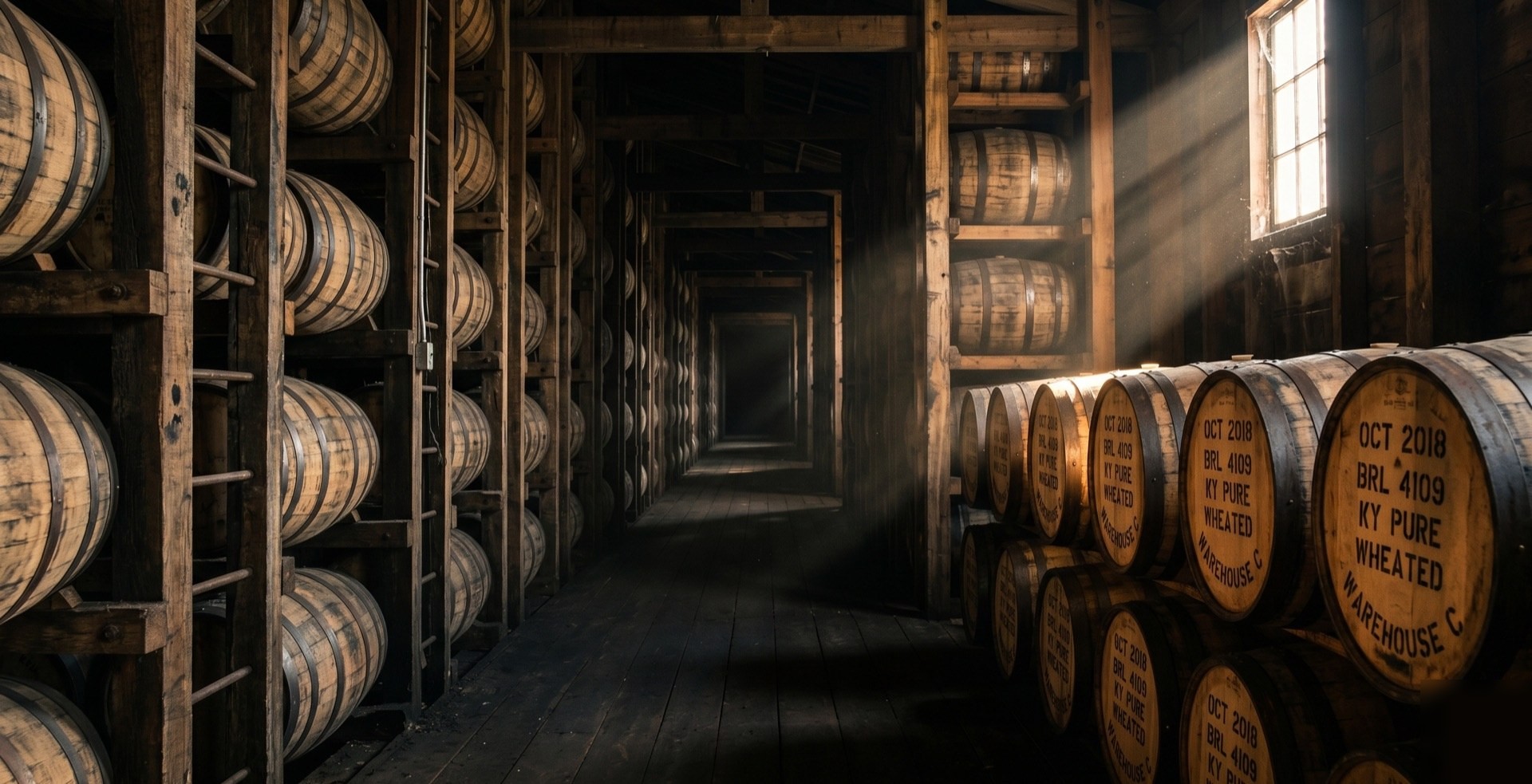
The scale is hard to picture. According to the Kentucky Distillers' Association, Kentucky is sitting on roughly 16.1 million barrels of aging bourbon — the largest reserve in the state's history, an estimated decade's worth of supply. Kentucky makes about 95% of the world's bourbon across 125 distilleries, an industry worth around $10.6 billion a year to the state. The warehouses are full.
What do you do when the warehouse is full and sales are flat? You stop making more. Jim Beam took its flagship Claremont distillery — home to a 65-foot still that fills a barrel roughly every 93 seconds — offline for the entire year, with the pause slated through at least 2027. (To Beam's credit, it reassigned workers rather than laying them off.) MGP, one of the big contract distillers that quietly supplies a huge swath of "craft" labels, also pulled back.
Nowhere is the glut more visible than in barrels themselves. New charred-oak barrels that commanded upward of $285 at the 2023–24 peak have dropped sharply. And used barrels — the ones distilleries normally sell on to Scotch and rum makers as a tidy second income — collapsed from more than $200 at the end of 2024 to around $50. Brad Boswell, CEO of cooperage giant Independent Stave, delivered the line of the year to the Journal: "If you got into this barrel business thinking you have never-ending growth and it's a seller's market, you're gonna be very disappointed."
For all that, demand hasn't fallen off a cliff so much as drifted down off a peak. American whiskey consumption hit a high of 31.2 million nine-liter cases in 2022, per the Distilled Spirits Council, and was still around 30 million in 2025. That's a soft landing in volume terms — but layered on top of a record glut and collapsing prices, soft is more than enough to hurt.
The Shake-Out Begins: Bankruptcies and the "Rinse Cycle"
When prices fall and warehouses overflow, the players carrying the most debt and the least cushion start to go under. In 2026, they did.
The headline collapse was Uncle Nearest. The brand built one of the great modern American whiskey stories — honoring Nathan "Nearest" Green, the formerly enslaved man who taught Jack Daniel to distill — and grew explosively. But in March, founder Fawn Weaver filed for Chapter 11 protection after a Kentucky lender alleged default on more than $100 million in loans. The filing turned ugly fast, with a court-appointed receiver — who said the company was insolvent with more than $200 million in debts — asking a judge to sanction Weaver for filing without authority. A brand that was an industry darling not long ago is now a cautionary tale.
It wasn't alone. Stoli Group's U.S. operations, including its Kentucky Owl American whiskey business, were declared bankrupt. Colorado's Distillery 291 cut staff from 30 to 12, and a San Antonio distillery closed outright, its owner citing tariffs and younger adults drinking less. The distress even reached the distribution backbone: RNDC, once the second-largest U.S. wine-and-spirits distributor, entered a national firesale this spring, issuing layoff notices to roughly 2,774 workers and selling its markets off to rivals.
The people who've weathered cycles before see this coming and, in a hard-nosed way, welcome it. At a Kentucky bourbon conference this spring, Rabbit Hole founder Kaveh Zamanian didn't sugarcoat it: "We're in the middle of the storm," he said, predicting "a bit of a rinse cycle" in which "a lot of folks get washed out — and that's good for the industry." His read on the consumer was just as sharp: "It's not about drinking less but better." Michter's COO Andrea Wilson offered the long view that has carried distillers through every prior bust: "Don't stop making whiskey now, because in 10 years, you'll need it."
Big Bourbon's Reckoning: Layoffs and a $15 Billion Bid
The squeeze isn't just hitting upstarts. The giants are restructuring in public.
Brown-Forman — one of the last great independent, family-influenced American spirits houses, with Jack Daniel's, Woodford Reserve, and Old Forester — announced it would cut about 12% of its roughly 5,400-person workforce and close its Louisville cooperage. Barron's noted the company was sliding toward a third consecutive year of declining sales, its global spirits market share having slipped to 5.9% (eighth overall, down from 6.3% in 2021) as the sector reckons with what it called, simply, "a decline in U.S. drinking."
That weakness made Brown-Forman a target — and set off a takeover drama worth understanding, because ownership shake-ups decide what ends up in your glass (we broke down why when Four Roses got a new owner). Bloomberg reported that the Brown family, which controls about two-thirds of the voting stock, actually favored a "merger of equals" with France's Pernod Ricard — an 80%-stock deal that would have diversified the company while keeping the family's influence intact. But those talks collapsed in late April. Meanwhile, rival Sazerac — the privately held Louisville maker of Buffalo Trace and Fireball — lined up a roughly $15 billion, all-cash approach. That offer carried its own problem: combined, Brown-Forman and Sazerac would control more than 30% of the U.S. American whiskey market, enough, analysts warned, to trigger an extended antitrust review. In May, Brown-Forman's board rejected it.
Picture it for a moment: the maker of Jack Daniel's and the maker of Buffalo Trace, two pillars of American whiskey, at the same negotiating table. Consolidation pressure like this is a symptom, not a strategy — when organic growth dries up, the fastest way to show shareholders a bigger number is to buy it. Expect more of this talk before the cycle turns.
The One Bright Spot — and Why It's Already Fading
If you're looking for the part of the spirits world that's actually growing, there's exactly one: ready-to-drink cocktails. The cans.
The numbers have been eye-popping — spirit-based RTDs grew around 26% to 30% for much of the year, and in a sea of red, any green looks like salvation. Sazerac's BuzzBallz, Anheuser-Busch's Cutwater, and hard-tea brands like Surfside and Sun Cruiser posted growth rates traditional whiskey can only dream about. Cutwater grew so fast it became the 10th-largest spirits brand in the entire U.S. by volume. Even Diageo, which had long stayed on the RTD sidelines fearing thinner margins, reversed course this year and made canned cocktails a strategic priority.
But the bright spot is dimming. RTD growth has been decelerating — from north of 30% earlier in the year toward 22%, and by April the category's volume had gone essentially flat even as dollars rose. The segment is now ferociously crowded, with more than 750 spirit-based cocktail brands fighting for shelf space, and the early winners are showing strain. A category that grows 30% one year and 22% the next, with hundreds of new entrants splitting the pie, is a category maturing fast.
The bigger issue for us bourbon folks: RTDs are propping up the spirits number, but not whiskey. The growth is in vodka- and tequila-based cans and hard teas, not bourbon in a can. So when you see a headline that "spirits volume grew," read the fine print — strip out the cans and the core categories, bourbon included, are still falling.
Meanwhile, a $162,500 Bottle: The High End Has Never Been Hotter
Now the other screen. Because while the middle and value tiers got hammered, the very top of the market threw the best party it's ever had.
That $162,500 Pappy wasn't a fluke. It came out of the Great American Whiskey Collection sale at Sotheby's, which raised $2.5 million in January — double its pre-sale estimate — and became the most valuable single-owner spirits auction ever held in New York. All 319 lots sold. The trophy-bottle world we've chronicled for years, from the cult of Pappy Van Winkle and the great "Pappygate" heist on down, isn't cooling. It's accelerating.
Collectors think this is just the beginning, and their logic is comparative: American whiskey is still cheap relative to its peers. A bottle of Scotch can fetch seven figures — the record is a $2.7 million Macallan — and rare Japanese whisky trades for hundreds of thousands. Against that, even a six-figure bourbon looks like a bargain with room to run. "Prices will continue to go up as long as prices are proportionally so much lower than other categories," Sotheby's global head of spirits, Jonny Fowle, told TIME. "There's so much room for growth." Mosoff framed America's 250th birthday as American whiskey's "Judgment of Paris" moment — the 1976 blind tasting that announced California wine to the world — arguing the category sits at the same inflection point. (We've told that larger heritage story in Bourbon Shapes American History.)
There is one structural catch on those global ambitions, and it's a rule bourbon is also defined by: by law, it must be aged in new charred oak. It's a beautiful constraint — it's what gives bourbon its signature flavor — but as Fowle notes, it also limits the range of styles American distillers can put in front of the world's collectors, one reason he thinks the category has further to climb before it's "universally appealing." Change the rule and you'd get more variety; keep it, and bourbon stays unmistakably itself.
There's even demographic data behind the optimism: a Bank of America report found 94% of Gen Z and millennials express interest in collectibles, with wine and spirits ranking high. The same young people drinking less, in other words, may be more inclined to collect than to pour. If this sounds familiar, it should — it's exactly what's happening in wine, where the average bottle price hit a record even as volume cratered, with $200-plus bottles growing while cheap wine fell. Two markets, splitting apart.
So, Where Are We Heading?
Pull it together and the industry's own central argument comes into focus: is this a cycle, or a turning point? The optimists, like American Whiskey Association CEO Michael Bilello, call the slowdown "primarily cyclical rather than structural — the category is coming off an exceptional multi-year run and is now recalibrating from a very elevated base." The skeptics, like BNP Paribas analyst Kevin Grundy, see "real, secular headwinds in the U.S." — a polite way of saying the party may not come back in the same form. The honest answer is probably some of both. But whichever wins, the shape of what comes next is already visible, and it's split.
Bourbon is bifurcating — separating into two markets that happen to share a name. At the top, scarcity and story still rule; the genuinely rare and old will keep appreciating, buoyed by collectors and by the simple fact that American whiskey is still underpriced next to Scotch. That end may barely notice the downturn. In the broad middle — the $30-to-$100 bottles most of us actually drink — the next couple of years will be a grind: more discounting, more "value" line extensions, fewer reckless price hikes, and a steady thinning of the herd as over-leveraged players wash out.
Exports are the swing factor few drinkers think about. American spirits are one of the country's genuinely great export products — sales abroad hit a record $2.4 billion in 2024 — but trade politics have whipsawed them: exports fell 9% in a single quarter in 2025, with shipments to Canada, long a top market, collapsing by as much as 85%. The industry's answer is to find new mouths — exports to Singapore jumped 43% as producers chase Asia's premium cocktail culture — and easing tensions with the U.K. would reopen lucrative markets and revive the used-barrel trade Scotch depends on. For a category sitting on a decade of surplus stock, finding those markets isn't a nice-to-have; it's part of how the glut clears. And the very category American whiskey helped define is now being chased by ambitious newcomers — Indian single malt is having its own breakout moment abroad — exactly the kind of competition that sharpens a category rather than killing it.
The wild card remains the one we started with: the drinkers. If the generational pullback from alcohol proves permanent, no amount of supply discipline fixes it — the industry simply gets smaller. But if "drink less but better" really is the new ethos, then bourbon — with its craft, its history, and its built-in romance — is about as well-positioned as any spirit on Earth to be the better people choose.
The Bottom Line for the Roadie
So, is bourbon in trouble? Parts of it, yes. The producers who over-built, over-borrowed, and over-priced are in for a reckoning, and some won't make it. But the category as a whole isn't dying — it's being sorted, and not always gently.
For those of us on this side of the bar, the practical news is good. The era of paying silly money and chasing empty shelves is easing. Bottles that were impossible to find are showing up again; prices that only went up are finally softening; and a decade's worth of well-aged whiskey is sitting in those full Kentucky warehouses with our names on it. The storm Zamanian described is real — but storms pass, and the distillers who keep their quality up and their nerve steady will be standing when it does.
The party that defined the last ten years is over. What comes next looks less like a frenzy and more like what bourbon was always supposed to be: good whiskey, fairly priced, shared in good company. We'll drink to that.
Cheers — and as always, drink the good stuff. There's about to be a lot more of it. (New to the lingo here? Our How to Speak Bourbon glossary has you covered.)
The Conversation