
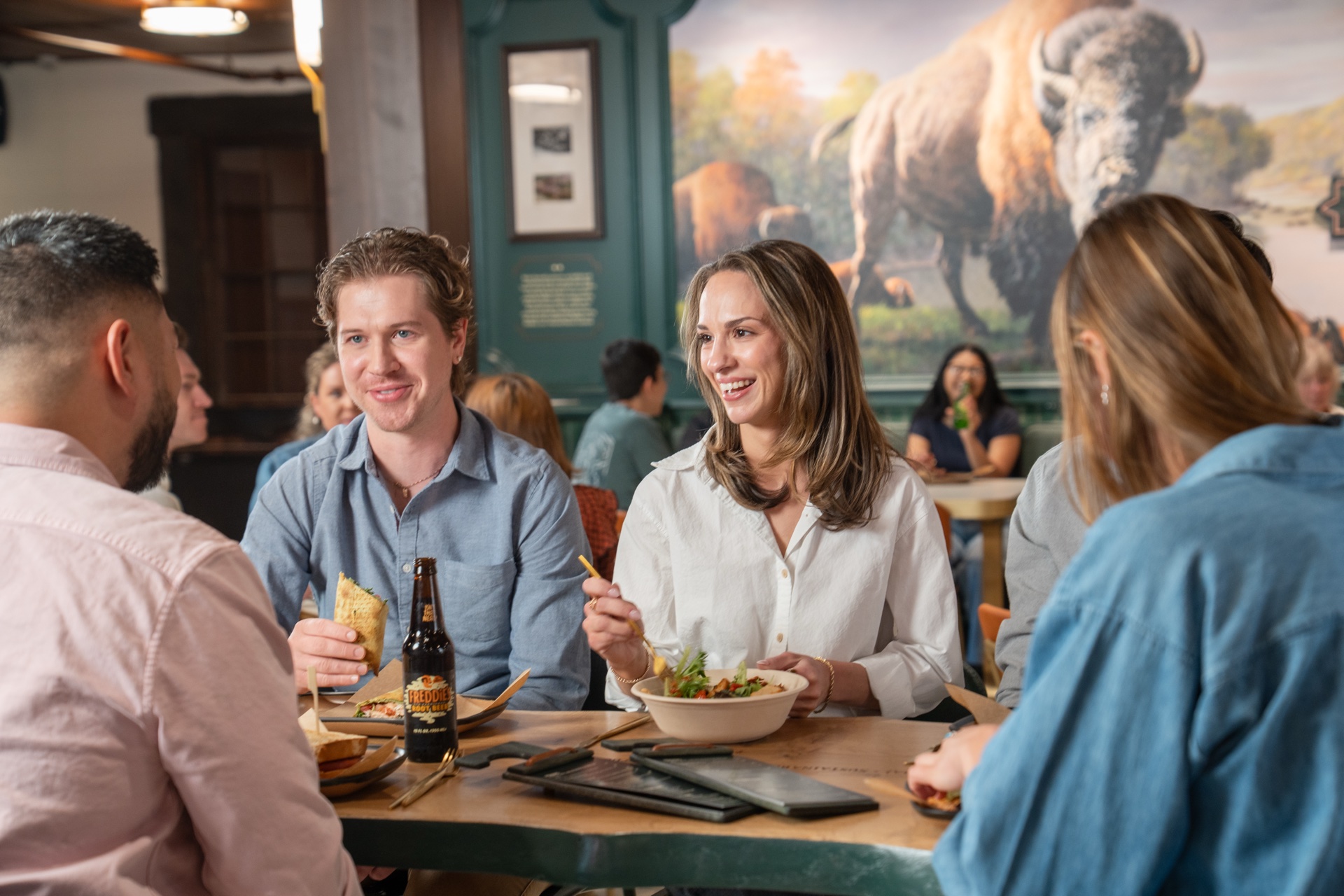
Buffalo Trace Distillery is opening its first-ever permanent dining destination on May 11, 2026. The John G. Carlisle Cafe is more than a lunch spot — it’s a tribute to resilience, a lost distillery, and a Kentucky statesman whose fingerprints are on the bottle in your hand.
There’s a particular kind of hunger that sets in about an hour into a Buffalo Trace Distillery tour.
You’ve smelled the mash cooking. You’ve watched the copper do its slow, patient work. You’ve walked the warehouses and breathed in the angel’s share. You’ve tasted a flight that runs from the flagship bourbon to something rarer, and your host has told you a story about Colonel Taylor that has made the hairs on your arm stand up. And then your stomach, practical thing that it is, reminds you that bourbon — glorious as it is — is not a meal.
For decades, the answer to that hunger was simple: drive downtown, find a table in Frankfort, and pick the tour back up later. On May 11, 2026, that finally changes.
Buffalo Trace Distillery has announced the grand opening of the John G. Carlisle Cafe, a permanent dining destination tucked inside the historic Elmer T. Lee Clubhouse. At 4,900 square feet, with seating for seventy guests inside and additional seats out on the patio, it is the first full-service restaurant to live on the property in the distillery’s more than 250-year history. And it’s opening almost exactly one year after historic floodwaters rolled through this same piece of land and put much of it underwater.
A Grand Opening Nearly a Year in the Making
To understand what the Carlisle Cafe represents, you have to rewind about twelve months.
In April 2025, unprecedented flooding tore across central Kentucky. Buffalo Trace — which sits on the banks of the Kentucky River in Frankfort — took a direct hit. The distillery had to close its doors to visitors. Operations were disrupted. Historic buildings, including the Elmer T. Lee Clubhouse, stood waist-deep in river water. For a place that has quietly, stubbornly stayed in production through Prohibition, world wars, and more bureaucratic regime changes than any business should have to endure, the flood was a reminder that geography eventually demands its due.
The team at Buffalo Trace chose to treat that reckoning as an opportunity. Rather than simply restore the Clubhouse and move on, they used the renovation to do something they’d been hearing guests ask about for years: open a real, permanent place to eat on the property.
The timing of the announcement isn’t an accident. The cafe is opening within weeks of the one-year anniversary of the flood. And inside the restored space, designers have left a deliberate scar: a subtle line marking the historic high-water level reached during the April 2025 flood. It’s a quiet design choice, and you could walk past it without noticing. But once you know it’s there, you won’t be able to un-see it.
“For years, guests have asked for a dedicated place to enjoy a meal while spending the day with us,” said Tyler Adams, General Manager of Buffalo Trace Distillery, in the distillery’s announcement. “The John G. Carlisle Cafe is a meaningful addition to the Distillery experience, opening this historic space to the public for the first time and inviting visitors to slow down, settle in, and fully immerse themselves in the atmosphere that makes Buffalo Trace so special.”
That emphasis on slowing down is worth pausing on. Most distillery tours are designed to move you through: check-in, welcome video, distillery walk, warehouse walk, tasting, gift shop, exit. You’re gently conveyed from one experience to the next. The Carlisle Cafe inverts that pattern. It’s a place to stop. To stay an extra hour. To let a couple of Kentucky Hot Browns and a cocktail rearrange the rhythm of your visit.
The Elmer T. Lee Clubhouse: Ninety Years of Gathering
The building housing the new cafe has a story of its own, and it’s one most casual visitors never hear.
Originally constructed in 1935 — just two years after the end of Prohibition — the Elmer T. Lee Clubhouse was designed from the start as a gathering place. Meals. Celebrations. Community. When the distillery across the street was still known as the George T. Stagg Distillery, the Clubhouse was where workers ate lunch, where birthdays were marked, where visiting executives were hosted, and where national dignitaries occasionally turned up for photo opportunities that ended up framed on a back wall.
Over the decades, the lower level of the building had quietly evolved into the beating heart of the distillery’s social life. Cafeteria. Breakroom. Company event venue. It had hosted every kind of gathering from informal Friday lunches to Christmas parties to hushed retirement send-offs for legends of American whiskey.
But the space had never been open to the public. Not once. For ninety years, this was the back of the house — a room only the people who worked here, or happened to know someone who did, had ever set foot in.
The Carlisle Cafe is, functionally, the first time those doors swing outward. The same room that fed the production team, that hosted Elmer T. Lee himself during his long tenure as master distiller, that still holds the echoes of decades of company dinners — that room is about to become somewhere you can book a table.
If you’re the kind of bourbon nerd who gets a little misty when you think about the continuity of this stuff — the people, the tools, the buildings, the barrels quietly aging while life happens around them — that alone is worth the drive to Frankfort.
Who Was John G. Carlisle?
Here’s the name question. Why John G. Carlisle?
If you haven’t heard the name, you’re not alone. He doesn’t get the historical marquee treatment the way Colonel E. H. Taylor Jr. or Pappy Van Winkle do, and you won’t find his face on a bottle. But his fingerprints are on every bottle of Bottled-in-Bond whiskey on the shelf — and that’s no small thing.
John Griffin Carlisle was born in Kenton County, Kentucky, in 1834. A lawyer by training, he became one of the most influential Kentucky statesmen of the late nineteenth century. He served in the Kentucky state senate, in the U.S. House of Representatives (where he was Speaker of the House from 1883 to 1889), in the U.S. Senate, and finally as Secretary of the Treasury under President Grover Cleveland from 1893 to 1897.
It’s that last job — Treasury Secretary — that puts him at the intersection of politics and American whiskey.
In the 1890s, the American whiskey market was the Wild West. Consumers had no reliable way to know what was in the bottle they were buying. Neutral grain spirit colored with iodine and flavored with prune juice got sold as “old Kentucky bourbon.” Honest distillers were being undercut by rectifiers and blenders who could mimic the label without the aging, the grain bill, or the craftsmanship. The entire category was on the brink of collapsing into a branding free-for-all.
The response, championed by Colonel E. H. Taylor Jr. and passed in 1897, was the Bottled-in-Bond Act — one of the earliest consumer protection laws in American history. The Act established that, for a whiskey to wear the Bottled-in-Bond label, it had to be the product of one distilling season, by one distiller, at one distillery, aged at least four years in a federally bonded warehouse, bottled at exactly 100 proof, and stamped by a federal agent. It was a government guarantee of authenticity before the FDA existed.
And the Treasury Department — John G. Carlisle’s department — administered it.
Carlisle’s support for the Act, and his willingness to commit Treasury resources and personnel to enforcing it, was not a foregone conclusion. Plenty of his contemporaries wanted the government out of the whiskey business. Carlisle disagreed. He believed that honest producers deserved protection from fraudulent ones, and that consumers deserved a reliable mark of quality on the bottle. When the Bottled-in-Bond Act passed just months before he left office, the Treasury infrastructure to enforce it was in place in large part because of his work.
Every time you pick up a modern Bottled-in-Bond whiskey — Colonel E. H. Taylor Jr. Small Batch, Heaven Hill 7-Year, Early Times, Henry McKenna, J. T. S. Brown, Old Grand-Dad — you’re drinking something that exists in its current form because of a law John G. Carlisle helped enforce more than 125 years ago. Naming the cafe after him isn’t a tribute pulled at random from a Kentucky history book. It’s a pointed acknowledgment that American whiskey, as we know it, owes him a debt.
The Lost Carlisle Distillery
There’s a second layer to the name, and it gets even more personal.
In 1879, Colonel E. H. Taylor Jr. — the visionary who would eventually shape the distillery we now call Buffalo Trace — built two distilleries on the banks of the Kentucky River in Frankfort. The first was the O.F.C. Distillery, short for “Old Fire Copper,” and that facility is the direct ancestor of modern-day Buffalo Trace. The second, built right alongside it, was named the Carlisle Distillery, in explicit honor of Taylor’s friend and political ally John G. Carlisle.
The Carlisle Distillery produced two main brands for its roughly forty years of operation: Kentucky River Whiskey and Carlisle Whiskey. It ran until Prohibition shut the doors, and unlike O.F.C./George T. Stagg, it never reopened. In 1936 — just a year after the Elmer T. Lee Clubhouse was built next door — the Carlisle Distillery was demolished. The timing is eerie. A year after the Clubhouse went up to celebrate the post-Prohibition rebirth of Kentucky whiskey, its sister distillery was flattened and paved over.
Most of the physical evidence of the Carlisle Distillery is gone. The buildings are gone. The stills are gone. The ledgers are scattered. But one artifact survived: a single bottle of Carlisle Whiskey, the only known example in existence, preserved for decades in the Buffalo Trace archives.
That bottle is now on display inside the cafe.
Think about the chain of custody required for that to happen. Somebody chose not to drink it in 1920. Somebody chose not to drink it in 1936 when the distillery was torn down. Somebody chose not to drink it during the lean years. Somebody chose not to drink it in the 1950s when the bourbon market was collapsing. Somebody chose not to drink it in the 1990s when distilleries were being sold off for scrap. And somewhere along the line, somebody chose to file it away in the archives rather than put it on a shelf. It has survived every temptation to be opened, every change in ownership, every warehouse move, and is now back home — in a building its namesake distillery once stood next to — where visitors can see it for the first time in nearly a century.
Alongside the bottle, the cafe displays rare period photographs of the original Carlisle Distillery, images of employees using the Clubhouse dating back to the 1950s, and other archival materials that have never before been shown to the public. It’s a small museum disguised as a restaurant.
What’s on the Menu
Let’s talk about the food, because a museum where you can’t order lunch is just a museum.
The Carlisle Cafe is built primarily around lunchtime service, which makes sense given the hours (11 a.m. to 3 p.m., seven days a week). The menu leans into classic American comfort cooking with a Kentucky accent.
- Made-to-order sandwiches — The core of the menu. Expect the kind of sandwich you’d want after walking five warehouses: substantial, well-dressed, built with real ingredients.
- Salads — For the day when a whiskey tasting is still ahead of you and you’d rather not take a post-lunch nap in the gift shop.
- Desserts — Including bourbon-infused fudge topping and bourbon-infused whipped cream options. If you can order both, you probably should.
- The Kentucky Hot Brown — The signature dish of Kentucky cuisine gets its own place on the menu. For the uninitiated: an open-faced sandwich of turkey, bacon, and tomato under a blanket of Mornay sauce, broiled until the top blisters. Invented at the Brown Hotel in Louisville in 1926, it is the Commonwealth’s single greatest contribution to American comfort food, and having one at Buffalo Trace feels correct in ways that are hard to explain.
The Buffalo Trace influence runs through the entire menu in small, deliberate touches. Bacon made with bourbon. Barrel-aged coffee brewed from beans that have spent time in used bourbon cooperage. Fudge topping spiked with Buffalo Trace. Whipped cream touched with a splash of bourbon. None of it is gratuitous. All of it is the kind of quiet, integrated branding that makes you realize halfway through a meal that you’ve eaten four different iterations of this distillery’s bourbon without feeling like you’ve been hit over the head with it.
The Cocktail Menu
The rotating cocktail list is, unsurprisingly, built around the Buffalo Trace family of spirits. Three opening-lineup cocktails have been confirmed:
- The Buffalo Trace Old Fashioned — The classic, done right, with the flagship bourbon. If this isn’t on the menu of a Buffalo Trace cafe, something has gone very wrong in the world. It is on the menu.
- The Wheatley Vodka Peach Mule — A summer-forward riff on the Moscow Mule, built with Wheatley Vodka (Buffalo Trace’s wheat-based vodka) and a peach twist that should play beautifully against Kentucky heat.
- The Traveller Whiskey Lucky Penny — The newest member of the Buffalo Trace family getting its cocktail debut. Traveller, the Chris Stapleton collaboration, is finding its cocktail footing, and this is a strong place to meet it.
The list will rotate. Expect it to follow seasons, new releases, and whatever the bar team feels like playing with. If you’re the kind of drinker who likes to track how a distillery uses its own juice in cocktail form, this is a bar worth watching.
Three Weeks of Grand Opening Celebrations
From May 11 through May 31, Buffalo Trace is rolling out a rotating three-week schedule of daily opening celebrations. It is, frankly, a lot. If you can only swing one visit during the month, you’re going to have to choose your day carefully.
Here’s how it shakes out:
- Monday — Free Meal Mondays (5/11, 5/18, 5/25). The first 100 guests each Monday receive a complimentary meal, with meal vouchers handed out at check-in. If you’re willing to show up early and queue, you can start your week with lunch on the house.
- Tuesday — From the Archives (5/12, 5/19, 5/26). An open-house event from noon to 2 p.m. hosted by Lead Archivist Nick Laracuente on the second floor of the Elmer T. Lee Clubhouse, featuring historical highlights and a curated archives display specific to the John G. Carlisle story. If you want the deep-cut distillery history experience, this is your day.
- Wednesday — Whiskey Wednesdays (5/13, 5/20, 5/27). Complimentary samples of a new, soon-to-be-announced Buffalo Trace release, served all day. Bottles will also be available for purchase in the gift shop in limited quantities. If the release is what I suspect it might be, this could be the day the allocation hunters circle in red ink.
- Thursday — Meet the Masters (5/14, 5/21, 5/28). A limited one-hour meet and greet inside the cafe with a rotating cast of Buffalo Trace royalty:
- May 14 — Harlen Wheatley, Buffalo Trace Distillery Master Distiller
- May 21 — Danny Kahn, Master Distiller and Director of Distillation and Aging Operations
- May 28 — Drew Mayville, Buffalo Trace Distillery Master Blender
- Friday — Freddie Fridays (5/15, 5/22, 5/29). Complimentary Freddie’s Old-Fashioned Soda — the craft soda line named for and inspired by Buffalo Trace Global Brand Ambassador Freddie Johnson — served inside the cafe. Freddie himself will be making special appearances. If you’ve ever been on a Buffalo Trace tour and ended up with tears in your eyes because of one of Freddie’s family stories, you already know why this is the day a lot of people will be trying to make happen.
- Saturday — Sippin’ Saturday (5/16, 5/23, 5/30). Seasonal, limited-time cocktails available in the cafe from noon to 2 p.m., plus a Buffalo Trace bourbon-infused chocolate pairing made in partnership with Frankfort’s own Rebecca Ruth candy company. Rebecca Ruth, for the unaware, is the oldest bourbon-ball maker in the state. A bourbon cocktail and a bourbon chocolate in the same room is the kind of afternoon you plan a weekend trip around.
- Sunday — Grain & Glass (5/17, 5/24, 5/31). Complimentary breakfast bites from 11 a.m. to noon, plus complimentary tastings of Colonel E. H. Taylor, Jr. Four Grain — a Bottled-in-Bond release from the Buffalo Trace Antique Collection–adjacent Taylor lineup. If the Bottled-in-Bond throughline of this entire cafe wasn’t already obvious, the Sunday tasting makes it official.
The whole lineup leans heavily into the distillery’s motto: Honor Tradition, Embrace Change. Archives on Tuesday. New release on Wednesday. The living legends of the distillery on Thursday. A new era of branded soda on Friday. Classic Kentucky chocolate on Saturday. And on Sunday, a tasting of a whiskey that exists in a straight line back to John G. Carlisle’s Bottled-in-Bond Act.
It is, essentially, a three-week working argument for why Buffalo Trace can be both one of the most modern distilleries in the country and one of the most historically grounded at the same time.
Planning Your Visit
A few practical notes for anyone who wants to make the trip.
The Carlisle Cafe opens May 11, 2026. Hours are Monday through Sunday, 11 a.m. to 3 p.m. That’s a relatively narrow window, so build your distillery visit around it rather than hoping to wing it. Walk-ins are welcome, but all guests must first check in at the Freehouse Welcome Center before heading to the cafe. Seating is community-style inside, which means you may end up at a table with another pair of bourbon pilgrims — which, in my experience, is one of the better ways to make a new friend.
The cafe is kid-friendly, so this is a genuinely all-ages stop, which is a rarity at a working distillery. Pets are not permitted. Dietary accommodations are available on request — just ask the staff. To-go orders and advance ordering are not part of the standard operating model; this is a place to sit down.
The address, for the GPS:
Buffalo Trace Distillery
113 Great Buffalo Trace
Frankfort, KY 40601
For details on the full grand opening lineup, including any updates or additional events, the distillery’s page at buffalotracedistillery.com/visit-us/cafe is the official source.
Why This Matters
It would be easy to write off a distillery cafe as a marketing upgrade. Another amenity. Another line item in the visitor-experience budget. But the Carlisle Cafe is doing something rarer than that.
It’s taking a building that has been a quiet center of the distillery’s working life for ninety years and inviting the public to sit in it. It’s taking the name of a politician most bourbon drinkers have never heard of and writing it in brass letters over a door, because without him, a whole category of whiskey might not exist the way we know it. It’s taking the only known surviving bottle of a whiskey from a distillery that was bulldozed in 1936 and putting it where you can look it in the eye over a turkey sandwich. It’s taking the flood line from April 2025 and carving it into the wall so future visitors can understand what it takes to keep a 250-year-old distillery running.
Honor tradition. Embrace change. A room that fed Elmer T. Lee now feeds the rest of us. A distillery that was underwater last spring is hosting open houses this May. The Commonwealth’s best sandwich, next to the Commonwealth’s best bourbon, inside the Commonwealth’s best-loved clubhouse.
Set a calendar reminder for May 11. And if you get there, order the Hot Brown.
The Bourbon Road covers bourbon culture, distillery news, and industry developments every week. Subscribe wherever you get your podcasts.
The Conversation