
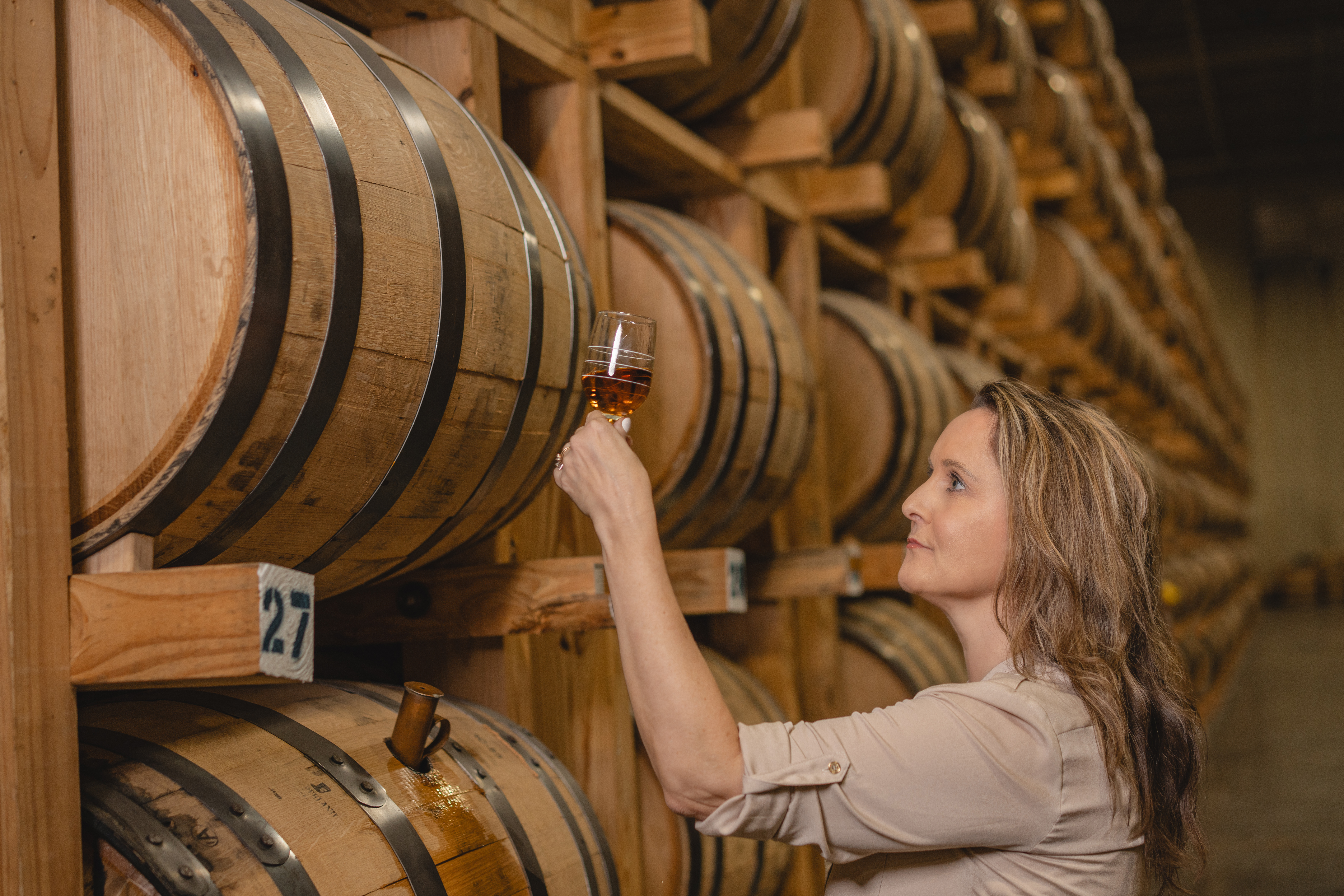
Sazerac officially names its Tennessee operation AJ Bond Distillery and prepares to debut its first Tennessee Whiskey in Summer 2026. The story behind the name is one of partnership, loss, and a legacy worth honoring.
On April 8, 2026, Sazerac — the company behind Buffalo Trace, Eagle Rare, Weller, and roughly 500 other brands — quietly made one of the most significant announcements in Tennessee whiskey in years. The company formally named its Tennessee whiskey operation AJ Bond Distillery, and confirmed that its first Tennessee Whiskey brand will debut in Summer 2026.
If you blinked, you might have missed it. There was no splashy launch event. No celebrity endorsement. No countdown clock on social media. Just a press release, a Dropbox link to some facility photos, and a name that carries more weight than most people will initially realize.
Because this isn’t really a story about a corporation entering a new product category. It’s a story about two people, twenty years of shared craft, and a whiskey that one of them will never get to taste.
The Names Behind the Name
AJ Bond. Say it out loud and it sounds like a brand — clean, strong, vaguely heritage-adjacent. The kind of name a marketing team might generate after a two-day offsite. But this one wasn’t manufactured. The “A” is for Allisa. The “J” is for John. And the “Bond” is exactly what it sounds like.
Allisa Henley and John Lunn began working together in 2004 at Cascade Distilling — the facility better known to most whiskey drinkers as George Dickel. Lunn, a Vanderbilt-educated chemical engineer, brought a rigorous scientific understanding of distillation chemistry. Henley, a Tennessee native who was originally hired to design the distillery’s visitor experience, had something arguably rarer: an intuitive, self-taught feel for the craft that she developed through years of total immersion in the production process.
They worked side by side for more than twelve years at Dickel, developing a partnership that was both technical and creative. Lunn understood the chemistry. Henley understood the spirit. Together, they built something that neither could have built alone — a shared philosophy of Tennessee whiskey production that would eventually become the foundation of an entirely new distillery.
When Sazerac came calling in 2016, they weren’t buying a building. They were buying that partnership.
The Popcorn Sutton Connection
The vehicle for Sazerac’s entry into Tennessee whiskey was the acquisition of a facility in Newport, Tennessee — in Cocke County, deep in the mountains of East Tennessee. The facility was known as Avery Trail Distillery, but most people in the whiskey world knew it by another name: the Popcorn Sutton distillery.
For those unfamiliar, Marvin “Popcorn” Sutton was one of the most colorful figures in American spirits history — a self-described Appalachian moonshiner whose autobiography, arrests, Discovery Channel appearances, and eventual death in 2009 (he took his own life rather than report to federal prison for moonshining charges) made him a folk legend. After his passing, the Popcorn Sutton brand was commercialized through a legal distillery operation in Newport.
It’s important to note what Sazerac actually acquired in December 2016: the physical facility, the equipment, and — crucially — the production team. They did not acquire the Popcorn Sutton brand name or any existing whiskey brands associated with it. This was a talent acquisition dressed up as an asset deal.
The talent they wanted was Henley and Lunn.
Building from Scratch in La Vergne
After the acquisition, Sazerac moved quickly. In 2017, the company modified the Newport facility’s pot stills to enable the Lincoln County Process — the charcoal-mellowing step that legally distinguishes Tennessee Whiskey from bourbon. But the Newport location was always transitional. In 2019, the entire operation relocated to La Vergne, Tennessee, a suburb of Nashville in Rutherford County, where Sazerac invested in a significantly expanded production facility.
La Vergne gave Henley and Lunn the space and resources to build their vision from the ground up. New equipment. Additional team members. Purpose-built warehousing for aging. And most importantly, the freedom to develop their own mashbill — one that would define what AJ Bond Tennessee Whiskey tastes like.
The details of that mashbill haven’t been disclosed yet. But if Henley and Lunn developed it together, drawing on their combined decades of experience at George Dickel, it’s safe to assume it reflects a deep understanding of how grain selection interacts with the Lincoln County Process. Tennessee whiskey production isn’t just about making bourbon and filtering it through charcoal. The best Tennessee distillers design their mashbills specifically for the charcoal mellowing — choosing grains and ratios that will produce the most interesting results after that subtractive filtering step.
That’s the kind of nuance that takes twenty years of partnership to develop. And it’s the kind of knowledge that can’t be replicated by simply hiring a consultant and buying equipment.
March 30, 2023
John Lunn died suddenly on March 30, 2023. He was a master distiller at the height of his craft, working alongside Henley to bring a whiskey they’d spent years developing to market. The whiskey was already aging in the warehouses. The launch was still years away. And just like that, the partnership that had defined two decades of their professional lives was over.
“John and I worked together for 20 years, and he played a major role in shaping my understanding of the chemistry behind distillation,” Henley said in Sazerac’s announcement. “We worked diligently to create every aspect of AJ Bond Distillery together. His absence is felt every day, but I know he would be proud of what we’ve created. It’s meaningful to know that the whiskey made here will carry his legacy forward.”
There’s a version of this story where Lunn’s passing becomes a footnote — a brief mention in a press release before the marketing language takes over. Sazerac chose a different path. They named the entire distillery after the bond between these two people. Not after a historical figure. Not after a geographic feature. Not after a founding family member. After a relationship.
In an industry that loves to mythologize its past, that’s a genuinely meaningful choice.
What Is Tennessee Whiskey, Exactly?
For readers who live primarily in the bourbon world, it’s worth taking a moment to understand what makes Tennessee Whiskey its own category — because the distinction matters, and it’s more than a marketing label.
Under Tennessee Code Annotated § 57-2-106, passed in 2013, any spirit labeled “Tennessee Whiskey” must undergo the Lincoln County Process: filtration through maple charcoal prior to aging. The whiskey must also meet the same basic requirements as bourbon — at least 51% corn, aged in new charred oak barrels, distilled at no more than 160 proof, entered into the barrel at no more than 125 proof.
The Lincoln County Process itself involves filtering new-make spirit through sugar maple charcoal before it goes into barrels. The charcoal is produced by burning stacks of sugar maple wood in carefully controlled burns, then crushing the resulting charcoal to a uniform size and packing it into large filtration vats. The unaged whiskey is then dripped or percolated through what can be up to ten feet of charcoal.
The effect is subtractive, not additive. The charcoal doesn’t add flavor — it removes it. Specifically, it strips out much of the oily mouthfeel and raw corn character that new-make whiskey carries. What enters the barrel is a cleaner, smoother spirit that will interact with the wood differently than an unfiltered bourbon would.
This is why Tennessee Whiskey has a distinct character from bourbon, even when the mashbills and aging conditions are similar. The charcoal mellowing creates a different starting point for the barrel aging process, and the resulting whiskey reflects that difference.
It’s also why master distillers who specialize in Tennessee whiskey are a different breed from their Kentucky counterparts. The Lincoln County Process adds an entire variable to the production equation — one that requires its own body of expertise. Henley and Lunn had that expertise in abundance.
The Competitive Landscape
When most people think of Tennessee Whiskey, they think of one name: Jack Daniel’s. And with good reason — the Lynchburg distillery, founded in 1866, has dominated the category so thoroughly that many consumers don’t realize other Tennessee whiskeys exist. Jack Daniel’s outsells George Dickel by approximately 100 to 1. That’s not a typo.
George Dickel, established around the same era as Jack Daniel’s and producing its first batch for commercial sale in 1964, has long been the respected underdog — smaller, more focused on small-batch production, and beloved by whiskey enthusiasts who appreciate its different take on the Lincoln County Process. (Dickel chills its whiskey before charcoal mellowing, which adds another layer of refinement.)
More recently, Nelson’s Green Brier Distillery has emerged as a legitimate third player. Founded in 2009 by brothers Andy and Charles Nelson, the operation traces its roots to the 1880s, when their great-great-great-grandfather Charles Nelson ran the Old No. 5 Distillery in Greenbrier, Tennessee — a facility that was shipping two million bottles a year by 1885 before Prohibition shut it down. The modern Nelson’s Green Brier uses a unique wheated mash bill, producing a softer, sweeter Tennessee Whiskey that has found a growing audience.
Into this landscape walks Sazerac, with resources that dwarf every Tennessee whiskey producer except Jack Daniel’s parent company, Brown-Forman. The question isn’t whether Sazerac has the distribution muscle to make AJ Bond a household name — it does. The question is whether the liquid in the bottle will earn its place at the table.
Based on who made it, there’s reason for optimism.
Why Sazerac, and Why Now?
Sazerac is not a company that moves impulsively. Founded in 1869 when Thomas H. Handy purchased the Sazerac Coffeehouse in New Orleans, the company has spent more than 150 years building what is now one of the world’s largest and most diversified spirits portfolios. The acquisition of the George T. Stagg Distillery in 1992 — renamed Buffalo Trace Distillery in 1999 — turned Sazerac into a bourbon powerhouse. The 2002 agreement with the Van Winkle family to produce Pappy Van Winkle at Buffalo Trace cemented its status as the custodian of some of America’s most coveted whiskeys.
Now in the fourth generation of family ownership, Sazerac has demonstrated a consistent pattern: identify exceptional people and places, invest for the long term, and let the whiskey speak for itself. It’s the same approach that turned Buffalo Trace from a mid-tier Kentucky distillery into arguably the most celebrated bourbon facility in the world.
The Tennessee whiskey play follows the same playbook. Sazerac didn’t rush to market with a sourced product or a rebranded existing whiskey. They acquired the right people in 2016, gave them the resources to build something from scratch, relocated and expanded the operation, and then waited nearly a decade for the whiskey to be ready.
In a spirits industry increasingly dominated by quick launches, line extensions, and marketing-driven releases, there’s something refreshing about a company that’s willing to spend ten years and significant capital before putting a single bottle on a shelf.
What We Don’t Know Yet
Sazerac has been deliberately vague about several key details, and that’s worth noting:
The brand name. AJ Bond is the distillery name, not the whiskey brand. The flagship Tennessee Whiskey brand name hasn’t been revealed yet. This suggests Sazerac is treating the distillery identity and the product identity as separate things — similar to how Buffalo Trace Distillery produces multiple distinct brands.
The mashbill. We know Henley and Lunn developed it together, and we know it’s designed for the Lincoln County Process. Beyond that, specifics haven’t been shared. Corn-heavy? Rye-forward? Wheated? The choice will tell us a lot about where AJ Bond intends to position itself in the market.
Age statement. The whiskey has been aging since at least 2017, when the Newport facility was modified for the Lincoln County Process, and possibly since the 2019 relocation to La Vergne. That gives a potential range of seven to nine years of age for the oldest barrels. Whether they’ll carry an age statement is unknown.
Proof and price. No details on either, but Sazerac’s track record suggests they’ll launch at a price point designed to establish the brand broadly rather than position it as ultra-premium out of the gate. Expect something accessible — this is a brand introduction, not a limited release.
Future expressions. The press release mentions “additional expressions and limited experimental releases” in the pipeline. This is consistent with Sazerac’s approach at Buffalo Trace, where a deep bench of experimental and limited releases keeps enthusiasts engaged while the core lineup drives volume.
Allisa Henley’s Moment
It would be incomplete to tell this story without acknowledging what Allisa Henley represents in the broader whiskey industry.
Female master distillers remain relatively rare in American whiskey. The industry has made progress — names like Marianne Eaves (Castle & Key’s founding distiller, though she has since moved on), Nicole Austin (formerly at George Dickel and now at a new venture), and Victoria MacRae-Samuels (Maker’s Mark) have raised the profile of women in distillation. But the numbers are still heavily skewed, and the title of Master Distiller at a major operation remains predominantly male.
Henley’s path is particularly notable because it wasn’t linear. She didn’t go to distilling school. She didn’t apprentice under a formal program. She started designing visitor tours at George Dickel and taught herself the craft through proximity, curiosity, and two decades of hands-on work alongside John Lunn. That she now leads what could become one of the most significant new distillery operations in Tennessee — and that her name is literally in the building — is a statement about how expertise is earned.
“From the very beginning, John and I knew we wanted to make a true Tennessee Whiskey, and we’re incredibly proud of the mashbill we’ve developed,” Henley said. “Seeing it now aging in our warehouses has been one of the most rewarding experiences of my career.”
When that whiskey finally hits shelves this summer, Henley will be the face of it. She’ll carry not just her own expertise, but the legacy of a partnership that shaped every aspect of what’s in the bottle. The “J” in AJ Bond isn’t silent — it’s foundational.
What to Watch For
A few things bourbon and whiskey enthusiasts should keep an eye on as the AJ Bond story unfolds:
The inaugural release. This is the most important bottle Sazerac has launched in years. Not because of hype — but because it represents nearly a decade of patient investment, a mashbill designed by two of Tennessee’s most experienced distillers, and Sazerac’s credibility in a category where it has no track record. If the liquid is exceptional, it validates the entire approach. If it’s merely good, it’ll be compared unfavorably to what Sazerac has achieved in Kentucky.
How Sazerac handles distribution. With their distribution infrastructure, Sazerac could flood the market overnight. The smarter play — and the one more consistent with their recent approach — would be a measured rollout that lets the whiskey build a reputation organically before scaling.
The experimental releases. The mention of “limited experimental releases” in the press materials is intriguing. Sazerac has turned experimentation into an art form at Buffalo Trace, where the Experimental Collection has been running since the early 2000s. If they bring that same spirit of curiosity to Tennessee whiskey, the category could see innovation it hasn’t experienced in decades.
The impact on the Tennessee whiskey conversation. For too long, Tennessee Whiskey has been treated as a footnote to bourbon rather than a distinct category worthy of its own enthusiasm. Jack Daniel’s dominance has, paradoxically, both defined and limited the category. A serious new entrant with Sazerac’s resources and reputation could expand the conversation — helping consumers understand that Tennessee Whiskey isn’t just “bourbon that went through charcoal” but a genuinely distinct tradition with its own craft, its own expertise, and its own identity.
The Bottom Line
AJ Bond Distillery is a bet on people. It always has been.
When Sazerac acquired the Popcorn Sutton facility in 2016, they were betting on Allisa Henley and John Lunn. When they relocated to La Vergne and expanded the operation, they were betting on the whiskey those two people could make together. When John died in 2023, Sazerac bet that his legacy — embedded in every aspect of the distillery he helped build — was strong enough to endure. And when they named the distillery AJ Bond, they were betting that the story behind the whiskey matters as much as what’s in the glass.
That’s a lot of bets. But Sazerac has been making long-term bets on people and patience for over 150 years, and their track record speaks for itself.
This summer, when the first bottles of AJ Bond Tennessee Whiskey hit shelves, they’ll carry the work of two master distillers who spent twenty years refining their craft together. One of them won’t be there to see it. But the bond that produced it — the partnership, the shared expertise, the years of quiet, patient work — is in every drop.
That’s a whiskey worth paying attention to.
The Bourbon Road covers bourbon culture, distillery news, and industry developments weekly. Subscribe wherever you get your podcasts.
The Conversation