
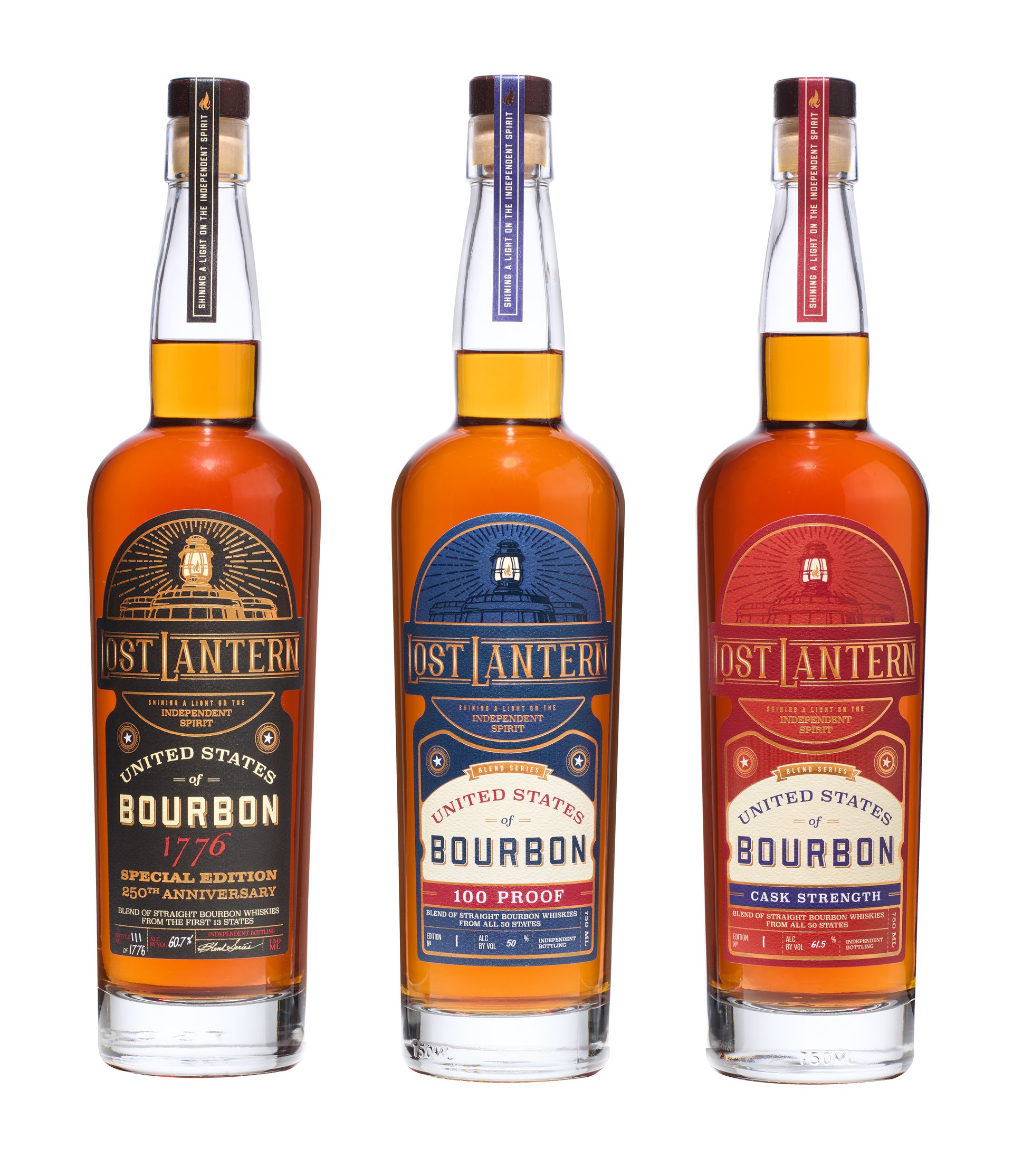
Every so often a release comes along that’s less a new bottle than a thesis statement about where American whiskey is right now. Lost Lantern’s United States of Bourbon is exactly that. It’s the first whiskey ever to blend straight bourbon from all fifty states — one distillery from every corner of the country, from Ko‘olau on O‘ahu to Denali Spirits up in Alaska, poured together into a single glass. Vergennes, Vermont’s award-winning independent bottler calls it the widest-ranging American whiskey ever created, and for once the marketing line is just plain true. Nobody has ever done this before, because for most of bourbon’s history it would have been impossible. There simply wasn’t bourbon worth bottling in fifty states.
There is now. And when Lost Lantern shipped us a bottle of the Cask Strength expression, we built a whole episode around it — Episode 501, “50 States, One Glass: The Ultimate 250th Anniversary Tasting.” Todd and I sat down with longtime Roadie Dan Mattingly and tasted it head-to-head against a flight of other 250th-anniversary releases. More on how it placed in a minute. First, the story behind the bottle, because it’s a good one.
An idea older than the company that made it
Lost Lantern is the project of Nora Ganley-Roper and Adam Polonski, two whiskey obsessives who left the media-and-retail side of the business to become a full-blown independent bottler. The concept of a fifty-state blend, it turns out, predates the company itself. “The United States of Bourbon has truly been years in the making and has been part of the vision for Lost Lantern since before we launched the company,” Polonski, the co-founder and Head of Whiskey Sourcing, said in announcing the release. “From the earliest stages of dreaming up Lost Lantern, we envisioned crafting a fifty-state blend to showcase the diversity and breadth of bourbon.”
That’s a tidy quote, but sit with what it actually describes. The pair started sourcing barrels specifically for this whiskey back in 2021, and kept sourcing them through 2025. Over more than five years they traveled the country — not metaphorically, but literally getting on planes and into rental cars — visiting distilleries, pulling samples, and tasting through what must have been an absurd number of barrels in search of one whiskey worthy of representing each state. In several states they considered multiple distilleries and countless samples before they settled on a winner. “I have visited and vetted every distillery in this blend in person,” Polonski said. That’s fifty distilleries, in fifty states, vetted by hand. It is, by any reasonable measure, one of the most ambitious blending projects American whiskey has ever seen.
Ganley-Roper, Lost Lantern’s Head Blender, had the harder job: taking fifty wildly different bourbons — different grains, different climates, different ages, different house styles — and making them sing together rather than fight. “This is certainly the most ambitious whiskey Lost Lantern has ever made,” she said, “but it has also always had true clarity of vision. I blended this to give a bird’s-eye view of bourbon from across the country. This whiskey provides a snapshot of the complexity and current landscape of bourbon.” That phrase — a snapshot of the current landscape — is the key to understanding what this release is really for.
What ‘independent bottler’ actually means
If you came up on bourbon rather than Scotch, the term “independent bottler” might not mean much to you, so it’s worth a beat. In Scotland there’s a centuries-old tradition of companies that don’t distill anything themselves. Instead they buy casks from distilleries, age and select and sometimes blend them, and bottle the results under their own name — names like Gordon & MacPhail, Cadenhead’s, and Signatory that whisky geeks revere. The independent bottler’s whole value is taste and trust: they go find casks you’d never encounter on your own and vouch for them.
That tradition barely existed in American whiskey until recently, and Lost Lantern is one of the houses building it here. They seek out distinctive whiskies from across the U.S. and release them as single casks and blends, with a near-fanatical commitment to transparency. On every United States of Bourbon label, all the component distilleries are named — no “distilled in Vermont” sleight of hand, no hiding behind a sourced-and-vague backstory. The whole point is to tell you exactly whose whiskey is in the bottle and why it earned its place.
The accolades suggest the approach is working. Lost Lantern was named Independent Bottler of the Year at the 2026 Icons of Whisky America Awards and again at the 2023 Global Icons of Whisky Awards. Both founders have been honored as Drinks Visionaries of the Year by Food & Wine, named Drinks Innovators of the Year by SevenFifty Daily, and turned up on the VermontBiz Rising Stars list and Beverage Information Group’s 40 Under 40. For a company operating out of a small town on Lake Champlain rather than Bardstown or Louisville, that’s a remarkable run of recognition — and it’s built entirely on selection rather than production.
One distillery per state — and what that range looks like
The romance of this release lives in the distillery list, which Lost Lantern publishes in order of statehood and even prints onto a map of the country with a barrel dropped on each state. Read it slowly and it doubles as a tour of how far craft distilling has spread. There are bourbons here aged in coastal climates where salty sea air works on the barrel, estate whiskies from family-run grain-to-glass operations growing their own corn, bourbon from states with generations of moonshining heritage, and whiskey from distilleries so new they’re younger than the idea for United States of Bourbon itself.
Some of the names will be familiar to anyone who follows craft. Kentucky is represented, fittingly, by New Riff, the bottled-in-bond standard-bearer in Newport. Tennessee comes from Leiper’s Fork, whose wheated single barrel we’ve reviewed and liked — a nice bit of overlap between a bottle we already know and this fifty-state portrait. Texas is Balcones, one of the producers that proved hot-climate American whiskey could be world-class. Nevada is Frey Ranch, the estate distillery near Fallon that grows every grain it distills and just cleaned up at the IWSC this year. Utah is High West; Washington is Woodinville; Missouri is the resurgent J. Rieger & Co.; West Virginia is Smooth Ambler. These are not filler. Several of them headline their own states’ whiskey scenes.
Then there are the names most drinkers have never heard, which is exactly the point. South Carolina is High Wire Distilling, doing remarkable things with heirloom Jimmy Red corn. Maine is Hardshore; Mississippi is Rich Grain; Louisiana is Distillerie Acadian; Wyoming is Backwards Distilling; North Dakota is Proof Artisan; South Dakota is Blackfork Farms; Idaho is Day’s Defile; New Mexico is Safe House; Arizona is SanTan. And at the far edges of the map, two distilleries that would have sounded like a joke a decade ago: Denali Spirits in Alaska and Ko‘olau Distillery in Hawai‘i. Bourbon — a spirit legally and culturally bound up with the American identity, but historically associated with a handful of states — is now genuinely a coast-to-coast, border-to-border craft. If you’ve ever wondered what a craft distillery actually is and why so many have sprung up, this single blend is the most concrete answer anyone’s offered.
Here’s the full fifty, in Lost Lantern’s order of statehood, because it deserves to be read once start to finish: Painted Stave (DE), Liberty Pole (PA), Sourland Mountain (NJ), ASW Fiddler (GA), Litchfield (CT), Triple Eight (MA), Baltimore Spirits Co. (MD), High Wire (SC), Cathedral Ledge (NH), Reservoir (VA), Kings County (NY), Broad Branch (NC), South County (RI), Stonecutter (VT), New Riff (KY), Leiper’s Fork (TN), Tom’s Foolery (OH), Distillerie Acadian (LA), Starlight (IN), Rich Grain (MS), Whiskey Acres (IL), Dread River (AL), Hardshore (ME), J. Rieger & Co. (MO), Rock Town (AR), New Holland (MI), St. Augustine (FL), Balcones (TX), Cedar Ridge (IA), Wollersheim (WI), Corbin Cash (CA), Far North Spirits (MN), Oregon Spirit (OR), Union Horse (KS), Smooth Ambler (WV), Frey Ranch (NV), Brickway (NE), Boulder Spirits (CO), Proof Artisan (ND), Blackfork Farms (SD), Montgomery (MT), Woodinville (WA), Day’s Defile (ID), Backwards (WY), High West (UT), Hochatown (OK), Safe House (NM), SanTan (AZ), Denali Spirits (AK), and Ko‘olau (HI). Fifty distilleries. One glass.
The blending problem nobody had solved
It’s easy to read “blend of all fifty states” as a logistics flex — the hard part being the travel and the paperwork. But the genuinely difficult work happened after the barrels were home. Think about what fifty states of bourbon actually means in a glass. You’ve got high-rye recipes and wheated recipes and four-grain recipes. You’ve got whiskey aged in Florida heat that races to maturity and whiskey aged in Vermont cold that crawls. You’ve got two-year-old craft spirit with bright, grain-forward energy sitting next to ten-year barrels gone deep into oak and leather. Left alone, those components don’t blend so much as collide. The default outcome of a project like this is a muddle — technically “fifty states” but tasting like none of them.
Avoiding that is the entire art, and it’s why Ganley-Roper kept circling back to the phrase “clarity of vision.” A bird’s-eye view only works if you can still make out the landscape; zoom out too far and everything turns to gray. The trick isn’t to let all fifty bourbons shout at once — it’s to arrange them so the blend reads as a single, coherent American bourbon that happens to have unusual depth and breadth underneath it. The age range is the giveaway here. Carrying components from two to ten years (and four to eight in the 1776 Edition) means she had both the young grain notes and the old oak to play with, and the slow-proofing on the 100 Proof tells you how carefully the dilution was handled to keep the thing from falling apart. That this blend held its shape on a tasting table next to single-distillery bourbons — which we’ll get to — is the real headline. The travel got the press. The blending earned the score.
The three inaugural expressions
The launch arrived as three distinct bottlings — two of them recurring members of a new Blend Series, one of them a true one-and-done. Here’s how they break down.
United States of Bourbon 100 Proof — $79.99
This is the flagship and the everyman entry point: the full fifty-state blend, blended in Vermont and carefully slow-proofed down to 50% ABV for a warmer, more approachable profile that still holds onto the blend’s depth. Lost Lantern made 6,780 bottles. It carries a 2-year age statement, with components ranging from 2 to 10 years old, and like all three releases it’s non-chill filtered with no color added. The official tasting notes read: warm vanilla and wood spice on the nose with hints of nutmeg and clove, then chocolate, raspberry, and orange zest on a balanced, deep palate. At eighty bucks for a transparently sourced fifty-state blend, this is the one most people will actually drink, and it’s priced to be opened rather than shelved.
United States of Bourbon Cask Strength — $99.99
Same fifty-state blend, same 2-to-10-year component range, but bottled at its natural proof of 122.9 instead of being brought down. Production is tighter at 3,300 bottles. This is the one we tasted on the show, and it’s the one I’d point a serious bourbon drinker toward, because cask strength is where you really hear all fifty voices in the choir. Lost Lantern’s notes: rich wood spice and vanilla on the nose, then oak, spice, and fruit intermingling into a deep, balanced whole, with black raspberry, dark chocolate, and leather. For twenty dollars over the 100 Proof you get the unfiltered, undiluted version of the same idea.
United States of Bourbon 1776 Edition — $199.99
This is the showpiece, and it’s a different animal. Created specifically for America’s 250th anniversary, the 1776 Edition isn’t a fifty-state blend at all — it’s a thirteen-state blend, drawn only from the original colonies that came together in 1776 to declare independence and form a new nation. Blended in Vermont and bottled at cask strength (121.4 proof), it’s limited to exactly 1,776 hand-numbered bottles and will never be repeated. It’s also the oldest of the three, with a 4-year age statement and components running 4 to 8 years. The notes promise something richer and more contemplative: warm, complex, and spicy on the nose with orange zest, dark chocolate, and walnut; a palate that bursts with fruit and spice, hints of fresh-baked bread, and leather leading into a very long, spicy finish. At two hundred dollars it’s a collector’s bottle, but a meaningful one.
The 1776 Edition and the weight of the 250th
It’s worth pausing on why the thirteen-state blend matters, because 2026 is wall-to-wall with anniversary bottles and it’s easy to let them blur together. The semiquincentennial — America’s 250th birthday — has every distillery in the country reaching for the flag, and a lot of those releases are a commemorative label slapped on existing juice. The 1776 Edition is different because the concept is the commemoration. Where the standard United States of Bourbon gives you a bird’s-eye view of the country as it exists today, the 1776 Edition rewinds to the founding and asks a genuinely interesting question: what does the bourbon being made in the original thirteen colonies taste like right now?
The answer is a blend of straight bourbon from Painted Stave (Delaware), Liberty Pole (Pennsylvania), Sourland Mountain (New Jersey), ASW Fiddler (Georgia), Litchfield (Connecticut), Triple Eight (Massachusetts), Baltimore Spirits Co. (Maryland), High Wire (South Carolina), Cathedral Ledge (New Hampshire), Reservoir (Virginia), Kings County (New York), Broad Branch (North Carolina), and South County (Rhode Island). Most people don’t think of New Jersey or Rhode Island or New Hampshire as bourbon country — and that’s the whole charm of it. A whiskey that, in 1776, could not have existed in any of these places now exists in all thirteen, and Lost Lantern bottled the proof of it. That’s a far more thoughtful tribute than another eagle on a label.
We poured the Cask Strength on Episode 501
Which brings us back to the show. For Episode 501 we leaned all the way into the anniversary theme and built a five-bottle flight of commemorative releases, with the Lost Lantern Cask Strength as the headliner. Todd Ritter and I were joined by Dan Mattingly — a Roadie since 2020 and a board member of the Frankfort Bourbon Society — which made for exactly the kind of three-way debate these tastings are best at.
The lineup, for the record: Old Fourth Distillery’s Dragon Con Bourbon (a 40th-anniversary bottle at 94 proof, $39.99); 15 Stars Kentucky County Six-Year Straight Bourbon (90 proof, $38); 15 Stars Kentucky County 12-Year American Whiskey (90 proof, $58); Copper & Cask’s Wave That Flag Nine-Year Double Oak Bourbon (117 proof, $74.99); and the Lost Lantern United States of Bourbon Cask Strength (122.9 proof, $99.99). Four 250th-anniversary releases and one 40th-anniversary curveball, side by side.
So how did fifty states in one glass actually drink against dedicated single-distillery bourbons? Better than a skeptic might guess. When we ranked our top three, the Lost Lantern landed second — behind the Copper & Cask Wave That Flag and ahead of the 15 Stars 12-Year. That’s a strong showing for a blend whose degree of difficulty is off the charts. The knock people brace for with a project this conceptual is that it’ll taste like a committee — muddy, compromised, the sum of fifty things cancelling each other out. It didn’t. Ganley-Roper’s blend held its shape: that rich wood-spice-and-vanilla nose was real, the dark fruit and chocolate came through, and the cask-strength delivery gave it enough presence to stand next to a 117-proof double-oak bourbon without disappearing. It earned its place on merit, not on novelty.
If anything, tasting it in that company clarified what United States of Bourbon is and isn’t. It’s not trying to be the single most intense pour on the table; the Copper & Cask edged it there. What it’s trying to be is a coherent, delicious statement — and as a statement that also happens to be a genuinely good drink, it more than delivered. There’s a version of this concept that’s all gimmick and no glass. This is the opposite.
Should you chase a bottle?
Realistically, that depends on where you live and how fast you move, because none of these are big productions. The 100 Proof tops out at 6,780 bottles, the Cask Strength at 3,300, and the 1776 Edition at just 1,776 — and that last one, by design, will never be made again. United States of Bourbon is available directly through LostLanternWhiskey.com and through Seelbach’s, plus select retailers in California, Illinois, Massachusetts, New Hampshire, New York, Rhode Island, Vermont, and Virginia, and at the Lost Lantern tasting room in Vergennes. If you’re outside those states, the online channels are your friend.
As for which one: if you just want to taste the idea, the $79.99 100 Proof is the move, and it’s priced to actually pour for friends rather than guard in a cabinet. If you want the fullest, truest version of the blend — and you tasted along with us on the show — the $99.99 Cask Strength is the pick. And if you’re a collector who wants a piece of the 250th that means something beyond the flag, the 1776 Edition is a real one-time artifact, hand-numbered out of 1,776, blended from the states where this whole experiment in country-building started.
More than any individual score, though, the thing I keep coming back to is what this bottle represents. Fifteen years ago, “bourbon from all fifty states” wasn’t a release anyone could make — it was a punchline. The fact that two people from Vermont could spend five years driving the country, find a worthy bourbon in every single state, and blend them into something that holds its own against established Kentucky-adjacent heavyweights — that tells you everything about where American whiskey is headed. Lost Lantern didn’t just bottle fifty bourbons. They bottled a moment. Pour a glass of it while it’s here.
Hear the full tasting and our rankings on Episode 501, “50 States, One Glass.” Cheers. — Jim
The Conversation