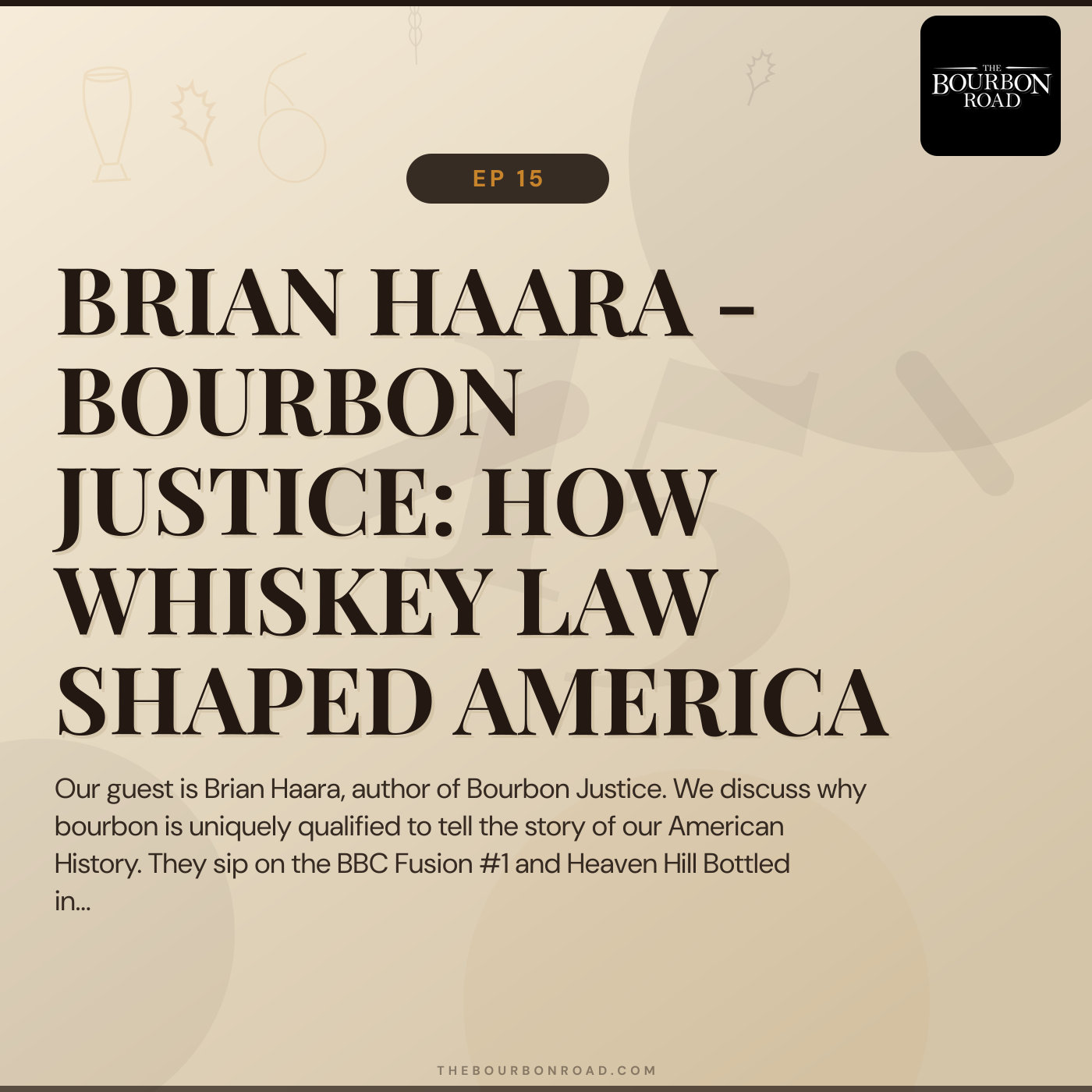
15. Brian Haara - Bourbon Justice: How Whiskey Law Shaped America
Brian Hera, author of *Bourbon Justice*, joins Jim & Randy with Bardstown Fusion Series and a rare Heaven Hill 6-Year Bottled-in-Bond to explore bourbon's legal history.

Reviews
Show Notes
Jim Shannon and Randy Minnick welcome listeners to another trip down the Bourbon Road with a fascinating guest and two exceptional pours. This episode features Brian Hera, author of Bourbon Justice, Louisville-based attorney, blogger at Sippin' Corn, and longtime contributor to the Bourbon Community Roundtable. Before diving into the conversation, Jim and Randy share their enthusiasm for Brian's book, which traces the surprising legal history behind bourbon's rise as America's native spirit — from the Bottled-in-Bond Act of 1897 to landmark trademark battles that shaped modern consumer protection law.
On the Tasting Mat:
- Bardstown Bourbon Company Fusion Series Kentucky Straight Bourbon Whiskey: A 98.9-proof, non-chill-filtered blend of three whiskeys — 40% 11-year 7-month bourbon (74% corn, 18% rye, 8% malted barley), 18% 2-year 3-month wheated bourbon (68% corn, 20% wheat, 12% malted barley), and 42% 2-year 1-month high-rye bourbon (60% corn, 36% rye, 4% malted barley). Light golden amber in color with a subdued, subtle nose showing light fruit and grilled corn character. The palate reveals dried fruit, vanilla, and a dry mid-palate, with a finish that carries leather and tannin notes attributed to the older stock. A showcase in skilled blending, where the aged component adds backbone and depth to the younger whiskeys. (00:04:08)
- Heaven Hill 6-Year Bottled-in-Bond Kentucky Straight Bourbon Whiskey (100 proof): A now-discontinued 100-proof, bottled-in-bond expression aged six years from a single distilling season at Heaven Hill. The nose opens boldly with classic caramel, vanilla, and a distinctive baking spice quality reminiscent of nutmeg and subtle cinnamon. The palate is fuller and warmer than the first pour, with the 100-proof heat coming through prominently on the mid-palate. The finish is longer and well-defined, with a satisfying warmth that lingers. Long considered a benchmark value bourbon and a yardstick for measuring quality in its price category. (00:29:41)
Brian Hera brings a lawyer's eye and a bourbon enthusiast's heart to a wide-ranging conversation covering E.H. Taylor Jr.'s complicated legacy, the origin of the phrase "brand name," the lasting legal shadow of Prohibition, and the marketing terms — craft, handmade, small batch — that remain undefined in federal regulations. He also shares his thoughts on the future of the bourbon industry, his admiration for Wilderness Trail and Castle & Key, and what it means to share a great bottle with the people you love. Bourbon Justice is available at bookstores in Kentucky, on Amazon, and at sippncorn.com — and if you're a history buff and a bourbon geek, this is the book for you.
Full Transcript
So why do you think the bourbon captured the attention of the legislature? Probably because they drank it, but whatever.
Well, you're exactly right. There's all kinds of stories about Abraham Lincoln finding out what General Grant drank, and it was Old Crow. and he wanted to send all of his generals a barrel of whatever Grant drank because Grant was getting it done. So he wanted to share that. The great compromiser, Henry Clay, would bring bourbon to Washington. So a lot of deals were done over bourbon.
Welcome to another trip down the Bourbon Road with your hosts, Jim and Randy. So grab a glass of your favorite bourbon and kick back.
We would like to thank Tommy and Gwen Mitchell from Log Heads Home Center for supporting this episode of the Bourbon Road. Find out more about their fine rustic furniture at logheadshomecenter.com.
Hey, Randy. Jim. I had some fun. I'm going to tell you what. Brian is just a wealth of knowledge. And when you read this book, Bourbon Justice, you don't realize how bourbon has really influenced the history of the United States. I mean, from branding and trademarking to, you know, the whole bottle and bond act, which started the whole USDA thing. Amazing. I was fascinated.
Yeah. I mean, you can take any level of information out of this book. If you're just kind of a casual bourbon follower, you can find a lot of great tidbits in there and information on bourbon, talking about bottling bond and some of the things that have gone on. But if you're a real geek and a history buff, There's all kinds of stuff in there.
You can dig pretty deep into this.
He's a wealth of knowledge, great guy. Great guy. Had a wonderful time today with him.
Yeah, fun to talk to you.
Fun to talk to you. He is not only an author, he's an attorney. He's worked in the bourbon field, in the legal field. He's also going to be in Burpin and Beyond this year. He's going to be giving a talk there as well.
Kind of cool. But the book is a good read and I really didn't want to read it to start off with, but once I got into this thing, man, I was just, okay, give me to the next chapter.
I mean, this is a theme I'm kind of getting from you. So you've got your terminal degree, you're a PhD, and you've done a little bit.
But that makes me want to just not do anything.
You've read enough books in your life.
I've read enough. I don't care. It's like, just leave me alone, you know? And so you just don't, you just don't want to take tests.
So this whole bourbon steward thing is like, wait a minute guys.
But I will do that just because bourbon is something I'm interested in, you know? And I would do that. But yeah, this, this book was actually pretty good to me. The tasting notes were great. I agree with him. That was a great way to kind of break up some of the laws and stuff. But there are some hidden stories in some of these lawsuits that are really, really interesting. And if you're a bourbon geek out there, yeah, man, this is the book for you.
I had fun. I enjoyed it. I really liked the book a lot. It was great to meet Brian. Great to have a couple of pours with him.
Oh yeah, good pours. Both good pours.
Hopefully we'll get together again sometime and do something a little less formal. Sounds good.
Like a third pour. Third pour.
Sounds good. All right. All right, let's get to it. Sounds good. Hello, I'm Jim Shannon. I'm Randy Minnick. And we are The Bourbon Road, and we are in Louisville, Kentucky today, and we are with Brian Hera. Brian is the author of Bourbon Justice, and we're going to get more into the book later, but Randy, what do you think we drink some bourbon? All right. Welcome to the show, Brian. Well, thank you.
Are you ready to try? I'm ready. Thank you both for having me. I look forward to this.
Yeah, so we do get into the first pour rather quickly. We try not to talk too much. What do you call it? Jibber Jabber, Randy? Something like that. But today what we've got is something new from the Bardstown Bourbon Company. This is the Fusion Series. And the Fusion Series is a new offering from Bardstown Bourbon Company and it is a Kentucky straight bourbon whiskey. It is a blend of three different whiskeys. One is an 11-year, seven-month corn, 74% rye, 18% malted barley, 8%. And this is an 11-year, seven-month bourbon. 40% of the product is that. It also has a couple of younger bourbons in it. One is a two-year, three-month weeded bourbon, 68% corn, 20% wheat, 12% malted barley. and then another two-year, one-month rye bourbon, 60% corn, 36% rye, and 4% malted barley. The two younger bourbons, the first one makes up 18% and then the rye bourbon makes up 42% of the total product. So yeah, there's about 60% young bourbon in this and about 40% well-aged bourbon.
So what is the proof on this?
This is 98.9 proof.
Almost made the bonded almost.
Almost. And well, and couldn't have been bonded for the other reasons that they go into it. But you're right. It always strikes me as funny when there's those small decimal points right after or right before 100. You wonder why. Right. Why not just do 100? Yeah.
Well, this is a 750 that we've received. I know they've sent out a lot of smaller sample bottles, sample kits to a number of media people. We didn't get ours from them, but it is a non-chill filtered bourbon. Great. Why don't we take a minute and see what we think about it. Good color. Yeah, it's a light golden amber.
It's darker than I would have thought for having 60%.
Younger stuff in it, yeah.
Two-year bourbon.
Now, for me, the nose is a bit subdued, muted, not real aggressive.
I agree with that. Pretty subtle.
Yeah. I never know what the right word is there, muted or subdued or subtle. I think all those work, actually.
If I get anything from the nose, it's a little bit like peanut brittle almost. Not peanuts, not peanut butter, but it's sweeter. So that's why I say peanut brittle.
Yeah. Yeah, I'm getting, I'm getting a little bit of like light fruit, kind of light fruitiness to it. And I do get the corn on it from the younger bourbon, but I think when you add in the older, maybe the older stock that's in there has given it a little bit of that smoky kind of, I like to say grilled corn or Mexican corn. I said that before. Yeah, you've said that before. I grilled Mexican corn. My vocabulary is so limited. I just keep going back to the same stuff.
It definitely has more of a backbone than a normal two-year bourbon, so it is nice to have.
That 11 years kicking in there, some body. That's right. Let's taste it. Cheers.
Cheers. Cheers. It's a lot better than I expected with 60% two-year bourbon.
I can taste notes from both though, I think.
Right. There's some of the younger characteristics in there. When I'm drinking a young bourbon, a lot of time it strikes me as green wood or just some heat without a lot of flavor. And I get some of that, but I'm getting a little more of that peanut brittle that I had on the nose. There's some good vanilla in here and all those things are going to come from a better aged bourbon.
And I get a little bit more of the dried fruit on it. I guess I'm a little more sensitive to the dried fruit. But, you know, it's kind of dry on the mid-palate.
I'm not even getting, you know, I call it round in the corner. I don't even feel it coming around the corner on this one per se, really. But the finish is pretty good.
A little bit of dry bitterness on there for me. But the finish, I feel, is long.
Yeah, I'd call it medium finish probably, but it's not disappointing at all. I mean, it fits with the rest of the bourbon.
But I get a little bit more on the back end of this. I get a little bit more leather and tannin kind of. It's that older stock. With that Mashbill, I've heard it said that that may be a Barton stock. They sure wouldn't have to go far to get it.
We wouldn't have to go far for it. There's a lot of rumors of Barton stock being sold. So that may be it, but I don't usually, and maybe I'm missing on this peanut brittle note, but that would strike me more of a beam signature.
Right. Well, I think it's respectable for me. I think it's good. I think it's a great offering. It speaks highly of what they're doing there. I'm pleased with it. I think it's good.
I think it is too, and what it really shows is what you can do with blending. I'd be interested to try each of the components separately and see if they came out with something that's better than the sum of the parts. I have a hunch that it probably is.
I don't normally lean towards bourbons that have a more bitter dry finish like this does, but I think it's very tasty. It's going to be fun to play with the percentages in this.
It would be. It shows a lot of skill to be able to do that.
So, Brian, do you live here in Louisville?
I do. I've lived here in Kentucky now longer than I have lived in Michigan. I grew up in Michigan, born and raised in Michigan. What part? Muskegon, Michigan, right on Lake Michigan.
Oh, wow.
Sort of place where you learn to drive a boat before you learn to drive a car and you go to deer camp and those sorts of things. a little bit shocked to the system to come down, but I came down for law school. And the story I always tell is I started my trip stopping in Ann Arbor. This is in March of 92. And there was two feet of snow on the ground, stopped in Cleveland at Case Western, and there was a foot of snow on the ground and then kept coming down 75 until there wasn't any snow. And that was Lexington. And it was the opening weekend of Keeneland. It was the Tuesday or Wednesday before UK played University of Michigan in New Orleans in the Final Four that year. And there were girls wearing shorts and buds on trees and flowers popping up. And I thought, I'll stay here.
You didn't continue south. You said, this is it.
This is it. I stopped where the first place that had those kinds of qualities.
See, the bourbon culture snookered another one, didn't they?
That's right.
So at that point, you had already decided you wanted to go to law school?
That's right. I sort of forced myself into it, which happens to a lot of lawyers. You're a political science and philosophy major and what else are you going to do?
But who goes into political science and philosophy unless the end game is law?
Well, that's right. A lot of people just end up doing it and have nothing better to do. But I did have, that was a goal of mine was to go to law school.
What made you pick law over something else?
It's just really that I think an interest in justice and I wanted to be part of that and I've tried to carry that through in my own professional career and obviously with the book that I'm trying to tell a story through justice. So it's just been a consistent theme of mine and interest of mine all these years, long before I ever thought I might write a book.
Well, any particular part of law?
I'm a business litigator, so I handle the types of cases that are in the book. I work on some bourbon trademark cases, some other bourbon cases, but a lot of what I do involves disputes between companies and disputes between owners of companies, the same sorts of things that E.H. Taylor was dealing with in the 1800s.
So was it by accident that you got into bourbon law, in a sense? Or did you enjoy bourbon? When did bourbon enter the picture for you?
Well, bourbon was definitely not in the picture in Michigan. I wouldn't have been able to tell you the difference between bourbon and Southern comfort, which is now sacrilege. And I'm going to lose some credibility, I think, by saying that I was ever in that position. But I had no clue. and really didn't know bourbon by its characteristics until I came to Kentucky. When you go to Commonwealth Stadium and you bring Jim Beam white label with you and when you have money, you bring makers and those sorts of things. So it was really not until I got here that I learned anything about bourbon.
So what was that first bourbon?
First Bourbon was probably Jim Beam white label. It's something you can afford on a student lack of income. And if it gets taken away by the security guards at Commonwealth Stadium, you're sad, but you're not out a lot. And it's solid. It's solid, right. It definitely holds its place. It's the best-selling bourbon, as I understand, and it's best-selling for a reason.
When did the bourbon culture bug get you, and what does the bourbon culture mean to you?
Well, to me, I think there's probably more bourbon subcultures than there is a bourbon culture.
Define that for us. Bourbon culture versus subculture.
Sure. With all the interest in bourbon now, I think you need subcultures. One of those subcultures are the flippers and sellers, the people who are in it for collections and they're on the closed sites and all they're doing is building collections and selling collections and trying to upgrade their collection. and they may be the same people who stand in line from 4am on just to get a bottle and all they're going to do is flip it. They're not really interested in drinking it and enjoying it. I think that's one subculture. You've got another subculture that that criticizes the articles in mainstream magazines that look like they're probably paid placements, paid reviews that aren't disclosed. And you've got a lot of conflict between those two groups. And then I think the subculture that I enjoy most, and then I think everyone listening to this is going to enjoy most, is the culture where we've found something that we all enjoy and we share it with everyone. Bottles of bourbon are meant to be open and they're meant to be shared with friends and family. And I think that's one of the subcultures that attracts a lot of people too.
So would you call that the bourbon appreciation group?
I think so, because they appreciate not just the bourbon in the bottle, but they appreciate what it can do with a group of people.
moment, if you will.
Exactly. You enjoy it in the moment and you can talk about anything and it's usually not politics and it's usually not things you're going to fight about, but it can go that way too. And as long as you're enjoying a bourbon together, that's fine.
I like it. So what is your daily drinker?
Well, I think my daily drinker depends on the mood and the moment. There is a time for 80 proof bourbons. There's not a whole lot of time for 80 proof bourbons, but there's a time.
The best example of that was my brother-in-law's bachelor party.
We're going out to some distilleries. So we had a bus and we were getting picked up at 9 a.m. or something like that. So we're not going to drink a barrel strength bourbon at 9 a.m. So I brought along a bottle of Basil Haydn's and it had just come out in the tube at that time. So the older guys in the group, I think, could appreciate that it wasn't a 6.99 bottle of Old Crow, but it's a nicer bourbon, but it's $80 and it's an easy drinker. Not that you're looking for easy drinkers at 9 a.m., but it was right for the moment. And by the time we got to...Woodford was our first stop. And by the time we got there, the bottle was killed and we were ready for a great day. And you wouldn't want to have done that with anything higher proof than 80. And I think 80 also works really well in the summer, even with ice in the summer, just to slow your roll. Sometimes you need to do that. If I'm at home and have a fire in the backyard, that's when I'm getting out of barrel strength. And probably some of my favorite barrel strengths have been Four Roses Private Selections and the Elijah Craig 12-year barrel proof. I'll take those any day of the week with just sitting by a fire and contemplating it sometimes just by myself. And I've got a neighbor who also likes campfires in the backyard and sometimes just the two of us.
There you go. Sounds great.
We've had them on one or two like that, I think.
You've heard the question before, the desert island bourbon. If you were to be stranded on a desert island, what's that one bourbon that you would want your, I don't know, 20 cases of to hold you over?
And it's the same bourbon? That's part of the test?
Or that's part of the question? Yeah, you're picking a single expression.
So if it's something that I could get, that's also part of the game. My favorite bourbon that's been relatively accessible has been a Four Roses Private Selection of OBSK.
OBSK.
It was about five years ago, maybe six, that there was a really great run of OBSKs and OESKs out of Four Roses. And I just fell in love with it. I don't think the more recent OBSKs have matched up to that quality. But now there's been some OBSFs that have come out that are fantastic. But if I'm going to pick my desert island, I'm bringing a few cases of OBSKs from about five, six years ago.
Still have a few left in the bunker, but you know it's gonna be interesting to ask him Jim Is who he would like to share that with past or present if you could drink a bottle with anyone? You say it would be four roses Who would that person tell you what let's break that down into two parts.
Okay. All right. The first part is non-family the second part is family
Non-family, without a doubt, I would love to go back in time and drink with Colonel Taylor. And whether that's a Four Roses or whether that's something that he made either at the OFC or at Old Taylor, that I think would be phenomenal. The guy is legendary for a reason, but he's got a lot of skeletons in a lot of closets. And I'd love to sit down with him. Now, part of the irony there is I've read in a few places that he didn't drink. So maybe he wouldn't be the right guy to share with. But at the very least, I'd like to sit down with him while I'm drinking one of those bourbons and have a nice conversation with him.
So open up a bottle and open up a closet door and see what we come up with.
That's right. There's a lot of digging to do. And his history has been whitewashed, I think, and cleaned up. And I'd like to dig in a little bit more and know the man a little bit better.
Any family member?
I got my dad into bourbon and really enjoyed having bourbon with him. I dedicated the book to him as well. He died this past January, but when he would come and visit from Michigan, I'd give him a new bourbon that I just got. We finished off Jefferson's presidential 17-year a few years ago. And so I'd always try to find the best bourbon that I had in my cabinet. And that's what we'd share.
That's great. That's great. So you're involved in legal work and you're doing so in the spirits industry.
That's right.
And you're also an author, a public speaker. You're a longtime guest on the Bourbon Community Roundtable. And what is the Bourbon Community Roundtable for those who don't know?
Sure, it was started by Bourbon Pursuit. Bourbon Pursuit is a podcast and the Bourbon Community Roundtable we try to do once a month more or less. And it's just an opportunity. We have a good vibrant chat community while we're doing it. So we live stream it and then it's edited and published later. But while we're doing it live, there's a vibrant chat community along with it and we try to tackle current topics. So the day that one of the Facebook groups got shut down, we happened to be recording that night. So we addressed that issue. When Mary Ann Eves left Castle & Key, we had her on and we talked about that a little bit. So we're mostly just a bunch of people talking about bourbon for about an hour. But we do try to address issues that are going on at that time in the bourbon world.
So that takes a lot of your time. I mean, you're busy with your job as well.
Right. I've got the day job. And the round table doesn't take too much time. And it's one of those things that's fun to do and fun enough that if it took more time, I'd be all right with it.
But you have a blog as well.
I have a blog that I probably need to post more on. It's called Sippin' Corn. And that's how I got started in bourbon writing. And that's really, I think fairly the genesis of bourbon justice is starting to blog in 2014 on Sippin' Corn.
So with all this extra time that you have, like what's next on the horizon?
Well, I used to say six or seven years ago that in five years, so five years from then, there would be a handful of bankruptcies on the craft distillers and I was going to buy a still on the cheap and buy some distillery property and learn how to do it myself. I was dead wrong about that bubble popping. It's still expanding. It amazes me. I don't know when or if it'll pop, whether we'll level out. But I really thought I'd be able to buy a sweet Vendome still on the cheap. Hasn't happened. But that's still a dream and probably needs to be something for retirement. But that's still a dream of mine is to actually learn how to do the craft.
Now, have you thought about the name? Have you thought about, would you buy an existing brand?
I haven't gone that far down the road in my head yet, but I would probably want to do it all on my own, not buy an existing brand. Just start from scratch all the way around.
Now, would you source upfront?
I don't even think I'd do that. It may be a necessity to do it. And that's what a lot of the distilleries faces. If they don't want to sell vodka or gin, they have to source from somewhere. So I totally understand that. By saying that, I don't mean to disagree with their choice. It makes a lot of sense to source and get your brand recognition out. If I could swing it, I would want to do it from the ground up.
What are some of your favorite new craft distilleries?
I've really enjoyed and I thought I didn't like gin at all, but I've had some gin from Castle & Key and I've tried their bourbon. It's obviously not ready for sale yet, but they're really doing the right things there. I expect some really high things from Castle & Key. The bourbon you brought here, they're doing some really good things. I had their collaboration last summer. that they did here locally with Copper and Kings. So I think they're doing some really good things. Beyond those, the releases have been so young that it's really hard to know what's going to come out.
What do you think about the one up in Northern Kentucky? New Rift? New Rift. Yeah, that's a good one.
I've only had New Rift once and it was good. I think it's getting a little more hype than it might deserve just yet.
Is that because of the source liquid that they had for a while, do you think? It's really caught on in the secondary, right?
Yeah, that has really caught on. And so that's maybe a good example of where it worked out great. They get a lot of MGP, they selected some great barrels, and they got their name recognition. So now people expect their make to be good. And it is good. What I've really liked, probably best of all, has been Wilderness Trail. Yes. Their rye is just phenomenal. And now they've got a little bit older bourbon too. We're still talking four and five years for these releases, but it's fantastic. It's phenomenal even. And I'm not just saying that for a four-year rye or for a four-year bourbon. I think compared to anything, it's legitimate.
Randy, if I have had the opportunity of tasting the four-year-old, and then we had a specialty pick that they haven't released any yet, but some that was pulled from a barrel, and it was just... The rye candy.
He's making me a rye fan. I wasn't necessarily a rye fan, but that willed it in its trail, because if you'd have asked me Kraft distiller, the whole thing coming up, I would have... The new rift I had, I was going, man, this is a solid product. I want to see what's going to happen down the road. That's right. Then he pulled out that wilderness, that rye. And I was like, okay.
And they're big enough that I almost don't think of them as craft. Right. I mean, they've got huge warehouses. They've got a really nice sized distillery. Craft, I guess, I think more of something that's that like a limestone branch had originally. When Steve Beam set that up, it was a really small still and he had bourbon barrels that he was using as fermenting tanks. So that was small scale.
It's really small. I think they actually claimed to be the smallest craft distiller still, right?
I think that's right. So that's what I think of. Wilderness trail, I think maybe fits just into the distillery category and you just call them a new distillery. But whatever you call them, that's something to watch out for.
All right. Well, Brian, we're hitting about the halfway point here. So what I think we should do is just continue to enjoy our pour. We'll take a little break here. And when we come back, we're going to do a little deep dive into your book and see what you brought for us to drink. Sounds great.
Look forward to it.
We would like to thank Tommy and Gwen Mitchell from Loghead's Home Center for supporting this episode of the Bourbon Road. Loghead's Home Center, nestled in the hills of Kentucky, is an industry leader in building handcrafted rustic furniture. Family-owned and operated, they take pride in offering only the very best for their customers. The Logheads, and that's what they like to call themselves, are skilled woodcrafters who are passionate about creating rustic furniture for people who appreciate the beauty of natural wood. Owners Tommy and Gwen don't just sell the rustic lifestyle, they live it. And you can be sure that Loghead's furniture will always be handcrafted in Kentucky by artisans who embrace the simple way of life. Loghead's rustic furniture is made from northern white cedar, a sustainable wood that's naturally rotten termite resistant. Its beauty and quality will add warmth to your earthy lifestyle for generations to come. Be sure to check out everything they have to offer at LogHeadsHomeCenter.com. And while you're at it, give Tommy and Gwen a shout on Facebook or Instagram at LogHeadsHomeCenter.
And we're back second half with Brian. Brian, we're going to get into this bourbon justice thing here in just a moment. Cause that's what excited me. I haven't read a book in quite a while, but before we get into that, you've got something interesting for us today in this second pour. Take it away.
Sure. What I brought and what I think would make sense both for Bourbon Justice and to compare to our Bardstown bourbon is the old six-year bottled and bond, white-labeled Heaven Hill. discontinued a year ago and I thought it was also a good one to bring because it's been in the news lately with the announcement that Heaven Hill will be releasing a seven-year bottled in bond at $40 instead of the $11.99 that this white label cost. And then also because I think this bourbon exemplifies every issue good and bad in bourbon right now. And I thought it could be a springboard for some discussion as well.
So why don't we go ahead and try this, this second pour of this heaven and hell, and then we can get into the good and the bad.
Sounds great. Yeah. It's got a hotter nose.
Absolutely. Now we let that other one sit there for about 10 minutes.
Well, that's a good point. So, right. So this was poured literally two minutes ago.
Right. But it's still pretty bold on the front end.
Hmm.
It's always got a good nose. The Heaven Hill Bottle and Bond is just, when you smell it, you smell what bourbon, what you think bourbon ought to be, I think. You definitely get a caramel vanilla waft off of it.
That's right. And that's a good way to put it. You're supposed to get caramel and vanilla in a bourbon. And Heaven Hill delivers on that.
But there's a twist on this nose that I can't put my finger on.
I mean, there's a little bit of spice to it and not, not over, not an over.
Maybe that's what I'm, I'm getting.
Um, a little bit of, um, I don't know, a little bit of nutmeg.
I agree. It's got some baking spice, a little bit of cinnamon in there.
I wanted to say cinnamon, but cinnamon usually is a little more pronounced than this.
This is a little more subtle, but whatever. But you get this, you get this nose on a lot of the Heaven Hill products. You get that kind of a nutmeggy nutty kind of,
So the color is pretty similar to our first pour. So that's 60% two-year bourbon, 40% 11-year versus bottled and bond. So meaning it's from, from one distillery from one distilling season.
And this is six years old here, but that doesn't mean it's six years old. It could be seven or a mixture of
Yes, the rule for age statements is that you put your lowest age in there. But this is going to, because it's bottled in bond, it is all going to be six years. Oh, that's right. Because they can't blend it with bourbon from another season.
I have been schooled, no doubt.
But you're right about that. If you see a non-bottled in bond bourbon, and it says six years, it could have eight year bourbon in it blended into it. This will not because it is bottled.
So distilling season, there's two distilling seasons in a year. So this would either be a spring or a fall distilling season. That's right, two seasons.
And the old tax strips for bottle and bond used to state which season it was. So that's why you look at the old dusties that will say fall or spring. that that went out with the deregulation in the 80s. So we don't know that it's not disclosed, but we do know it's either the fall or spring season.
Well, cheers.
Cheers. Heat comes through on the definitely does taste as well.
This is a little this is a little bolder than the than the other one we had earlier. I agree.
Definitely. Finishes longer. But the heat is dramatic in comparison to the first pour.
It is.
And the proof was, would you say it's almost under?
98.9, I think. A little bit higher than body temperature.
So we're basically equivalent on proof point, but it's an example of bourbons being similar proofs and one can taste a lot hotter.
But in a good way.
But in a good way. Right. It's not distracting, but in comparing the two, this is so much hotter for essentially being the same proof.
Yeah. And it's hot enough on that backend that it kind of overpowers the mid to me.
This is a well-rounded bourbon. I think it was missed. I think it was missed by a lot of people. Would you say it was the hands down choice for value bourbon?
I think it had to be, and it's a limited distribution. We were lucky to have it in Kentucky forever, however long this has been around. And then it was only in a few other states. But at $11.99, this is hands down the price performer, I think, in all of bourbon.
Is that part of the controversy nowadays, I guess?
I think part of that is it's what stings consumers and enthusiasts is that we had such a value bourbon and you never want to give up something that's good and that is a value. And then the controversy really comes in because of the announcement of releasing a seven year bottle and bond at $40 a bottle, then Kentucky is not even a release date.
So it's not, so Kentucky won't even be involved.
not even involved, at least on the initial release. So it's part you just, you don't want to miss out on something that you had access to before. And I think that's really what's driving some dissatisfaction among consumers with this, which I don't blame Heaven Hill for doing this. This was underpriced by anyone's definition. This six-year bottle and bond was underpriced. And a seven-year bottle and bond, I think, is fairly priced at $40.
Could they have shot the price up on this one a little bit, maybe had it a little mumbling and grumbling, but not too much and still kept a lot.
And I think that's what some brands are doing. You're seeing some brands on a yearly or 18-month basis inching their prices up, and sometimes retailers are doing that. and not waiting for the brands to do it, but they're doing it themselves.
Well, when I first moved to Kentucky and started learning about bourbon and whatnot, you know, I had heard somebody tell me, well, a lot of bourbon drinkers came from the cognac drinkers whose product got overpriced. And they said they needed to move to something else. They were tired of paying these high prices for a product that they had bought for many years and they were like, okay, let's try something else. I wonder, hopefully that doesn't happen to the bourbon industry, but are we starting to price ourselves above where we are?
Well, I think we were underpriced for a long time, especially if you look at scotch. and a bourbon that is or was equivalent to a scotch as far as what scotch drinkers like and what bourbon drinkers like could be $60 less than the equivalent bottle of scotch. So I think we probably have a little more room to grow and that probably makes the brands happy. But I think you're right, there's a danger of going past wherever that threshold is. And I'm sure they have marketers and people a lot smarter than me trying to figure out where that line is to go right up to it.
Well, this, this bourbon has a great finish. It really does. I think it's a, it's a good one.
It definitely shines on the finish.
So good and bad.
So the good and bad. Part of the good is that this is an accessible bourbon that was priced at a value. Part of the bad is that it's happening more and more where people hoard bourbon. And people would buy this up by the case and either sit on it or flip it, which I see is another downside of bourbon and it's driven by the collectors. And I think this six-year bottle and bond is going for 40, 50, $60 on the secondary market. when you've got a $12 bourbon. So I think that detracts from the overall experience. So it shows what can be done with a six-year bourbon, which is another, I think, great point of this. I always have treated this bourbon as a yardstick for measuring other bourbon. So I was really interested in putting it up against the first pour because if a craft distillery can't exceed the quality of the Heaven Hill six-year bottled and bond for $12, I sure shouldn't be paying $60 for it. Now I don't know what bourbon we're going to use to do that measurement.
So when this is reintroduced as a seven-year bourbon, I would think at some point it will be available in Kentucky.
It'll have to be, at the very least at the gift shop.
Will it then be a yardstick for $40 bourbons?
It may be. $40 is a crowded market right now, so it'll be harder, I think, to compare a $40 to a $60. The price disparity is just so extreme when you could get this at $11.99 and then compare it to a $60, $70, $80 craft bottle. that it could be so extreme that it made a lot of sense. If this was better than that, it's easy. The call is easy. Now, if you're comparing a $40 to a $60, well, I think pallets can disagree and $20 might not be here near there.
And this one side by side with the Henry McKenna bottled in bond?
Which do I like between the two? Yeah. There have been some Henry McKenna's that I've really, really liked.
Because it's a single barrel.
Because it's a single barrel. Right. And it's also 100 proof. It's also a Heaven Hill product. So there's going to be a lot of similarities between Henry McKenna 10 year and the Heaven Hill 6 year. There have been a lot of bottles of Henry McKenna 10 year bottle and bond that I have absolutely disliked. Some have just been too hot and thin and I wonder how they ever passed whatever. I'm sure there's a lot of people that taste it with better palates than me, but I sure didn't like it. So those have been hit or miss to me, but that's also a great value to be able to get a 10-year age-stated bottled and bond bourbon for $30. It's unheard of. Right.
I got one with an inch in the bottom of it that I don't want to get rid of because that one was excellent.
Right. There've been some that's just phenomenal.
Phenomenal. I mean, it's straight across, I mean, the front end, the mid-palate, the finish on that. I'm sitting there going, is there, for the price, there wasn't anything better to me. But I have a bottle of Heaven Hill this six year that sits there and I'm not going to open it until there's a special occasion. That's right. You know?
I agree. There are definitely some special occasion bourbons. People say it's meant to be opened. I say it's meant to eventually be opened because there are special occasions and you do want to save some for a special occasion, for a wedding, for a special birthday, for those sorts of things, but do eventually open it.
Well, that's true, but it may be the last one I get.
Yeah, I know I did a review on some, on a Henry McKinnon bottle in Bonn. I remember saying in the review, some are good, some are great, and some will bring a tear to your eye. I mean, there are a couple bottles out there that are just phenomenal and how they make it into the judging.
I wonder the same thing.
Yeah, but there are some good ones out there. Randy's got an excellent one as well. Yeah, that one was just...
I wasn't a McKenna fan. I didn't even think about even trying it until I got that one there and I go, give me some more.
Well, and that's part of the issue with single barrel and waiting to open a bottle. If you would have opened that the night that you got it, you might've been able to get back to the store and find that same barrel.
That's true. That's the problem. I have too many open bottles because that's exactly what I do. I typically open them pretty quick. Well, let's start talking a little bit about your book. What really inspired you to write Urban Justice?
I stumbled on it and I'm becoming a bigger and bigger believer that you stumble into some of the best things in your life. In this case, I didn't have any idea in my head that I would write a book or that I would start a blog. But I was at a Woodford tour, and everyone's been to Woodford multiple times, and I had been there multiple times. And the work week after being there on one of those occasions, I was researching for an entirely different case, nothing to do with bourbon in the slightest. But when lawyers research, we research on an online database using keyword searches, and you get false hits. that somehow the words match up and you're reading a case that has nothing to do with Juwan and you move on. This one that this false hit that came up was a case from the 1800s and it was about bourbon. So I thought, well, I'll read it anyhow. And it turned out I could tell that they were talking about the distillery that I was just at the weekend before. I could tell they were talking about Woodford. And the case was about a guy named Oscar Pepper, which is not a name that I had ever heard before reading the case. And I had heard of Colonel H. Taylor, and he made it into the story of the case. And I thought, well, now he's the guy at Old Taylor, and he's the guy at the OFC. He didn't have anything. What did he have to do with this? I didn't know anything about that. It was a really interesting case and it's featured in the book, but that's really what got me thinking that there's a lot of Bourbon history that's buried out there that I have access to, that I can find. It's stories that they're not telling at the distilleries because when I was just there the weekend before, they didn't say anything about Oscar Pepper. They didn't even say anything about James Crow. And that was a name that I had heard. And I think a lot of people have heard as basically the Scottish immigrant who brought a scientific discipline to the sour mash method. And he's the namesake for the old Crow brand. and the tour guide hadn't said anything about Crow either during the tour. So I started thinking that there must be hidden history in lawsuits and either it's hidden either because it was lost during prohibition or it hasn't made it into the marketers talk track for the story they want to tell or it's things that they really don't want people to know about. Because litigation, believe me, I know people don't want to talk about litigation even when they win the case. You just don't want to acknowledge that you've been in lawsuits a lot of the time. So a lot of these things, I can understand why they don't talk about them anymore, but I knew there must be more hidden history out there. So I looked for more cases and I found what I believe to be the true origin story of Maker's Mark. And it's not exactly the story they tell on the distillery tours. And then as I got more and more into it, I was able to get deposition transcripts and trial testimony and trial exhibits from the archives in Frankfurt. And I kept finding more and more information. that wasn't always the same story that the marketers tell. And as I talked with other people about what I was finding, I realized I need to share some of this. So it started with the blog. And by the time I had done that for a couple of years, there was enough material that I knew I could still write about that it would justify a book.
Well, the first thing that hit me when I was reading your book, and let me see if I can get the wording correctly here, was that, and so I'll just ask an informal question. What makes Bourbon uniquely qualified to tell the story of our American history? I just found that fascinating, you know?
Right. That's part of my thesis statement is that this is the way to tell this story. So that's a great question, and I'm glad you asked it. Part of the reason is that Bourbon is the only thing that is, by resolution of Congress, and America's, they don't say America's native spirit, but that's the way everyone refers to it. It's distinctively American, is what the congressional resolution says. There's no other spirit, there's no other food that is distinctly American. And as I read what was going on in the 1800s and early 1900s in the Bourbon world, I realized that it tracked what we all know of loosely as the American spirit. You've got immigrants coming over, bringing their trade and bringing their experience, bringing their know how and adapting it to what we have here. So if if they were Scottish immigrants who are used to distilling barley, corn is what's plentiful in Kentucky. That's what they used. Rye was more plentiful in Pennsylvania and Maryland. And that's what they use. They they adapted and they found ways to improve it. Then with the American experience, we also think of the snake oil salesman. That played a role with bourbon with rectifiers who would, because there were no labeling laws, could make a spirit in a day with neutral grain spirits and then add some safe and some unsafe additives to it. and put bourbon right on the label. And it was a total buyer beware mentality. And then we became a nation of laws. So we transitioned out of this buyer beware, out of this laissez-faire attitude into the nation of laws that we're in now. And some people I think fairly would say too many laws, too many regulations. I think the bourbon industry really is burdened by too much regulation now as are a lot of other industries. But we're a nation of law. We're rule followers. But because of what I think people see as the American spirit, we bend those rules where we can and we use those rules to our advantage to keep other competitors out when we can. And Colonel Taylor, I think exemplified that along the way because he pushed for the Bottled and Bond Act of 1897. And that's the tie in for one of the reasons that I brought the bottle. It was the nation's first consumer protection law. So before the government decided that it should protect its citizens, from tainted milk, which was being tainted at the time. They were watering it down and then adding glue to give it thickness again. Before the government decided it should protect American citizens from the atrocities that were going on in meatpacking plants, before they would protect consumers from anything else, the first protection was from rectified bourbon. And then that was followed by the Pure Food and Drug Act, more protections. That was broader, but that still had a bourbon component in it.
So why do you think the bourbon captured the attention of the legislature? Probably because they drank it, but whatever.
Well, you're exactly right. There's all kinds of stories about Abraham Lincoln finding out what General Grant drank, and it was Old Crow. and he wanted to send all of his generals a barrel of whatever Grant drank because Grant was getting it done. So he wanted to share that. The great compromiser, Henry Clay, would bring Bourbon to Washington. So a lot of deals were done over Bourbon. And I think that plus the drive of Colonel Taylor and the connections, the political connections that he had, he probably wasn't too terribly concerned about consumers in reality. He was really doing this to protect his livelihood because rectifiers could make a cheaper product a lot quicker and undercut manufacturers or producers of straight bourbon whiskey. So he was losing in the marketplace. And he used the law, maybe we'll call it under the guise of consumer protection, to protect his business.
And he was a very proud man.
Oh, extremely.
Yeah. So if you go to the distillery tour, they play that short video there at Buffalo Trace, and then the voice of Colonel E.H. Taylor, and he talks about how great he is and how awesome he is and how wonderful his products are. But yet almost got ran out of Kentucky on a rail.
Well, I think he did get a run out of Kentucky on a rail. He had a roller coaster career. He had a lot of ups and downs and he spent money like more was going to keep coming in and he went broke a few times. And one of the times that he went broke He had to sell, I don't know about had to sell. He ended up to try to cover himself, selling the same barrels of bourbon twice to two different purchasers. So when one came to collect his barrels, they were already gone. Some were in St. Louis with George T. Stag, others were with a warehouse company in Louisville. And he literally had to leave the state to avoid creditors. And he left his son there to try to pick up the pieces.
Well, when we talk about the history of the United States, evidently, bourbon played a role in what we know as trademarking and branding. At least you kind of mentioned this in chapter three of your book. Without going into a whole chapter, you know, give us an overview.
Well, and this is one thing that really surprised me. I learned a lot as I was researching. And one of the things I learned is that the phrase brand name that we all say on a on a regular basis now, and that we all think of in terms of what brand names are reputable. And Forbes ranks the most recognizable brand names. The phrase brand names comes from whiskey. Because since the late 1800s, mid to late 1800s, the federal government required bourbon producers to burn onto their barrel head, government required information. And every single bourbon producer had to do that. And they would put it on there with a brand. And that became known as the brand name, because this was before bourbon was sold in bottles. So when you would go to your tavern, they would have barrels of whiskey behind the bar, and they would have them facing out with the brand name. And you could ask for Old Crow, or you could ask for OFC, or you could ask for Old Oscar Pepper. And that came to be known as brand name.
Huh.
How about that? Every day is a school day, ladies and gentlemen.
That's right.
So in the book, you refer to small batch as almost a meaningless thing. And you also talk a little bit about single barrel, craft and finishing. Can you elaborate a little bit on those fours?
Sure, there's a lot of marketing terms that aren't defined in the regulations. The regulations now are called the standards of identity, and that's where you find the rules that bourbon has to be a certain mash bill. Everyone, I think, knows that it has to be majority corn. And then beyond that, it doesn't matter, but it's got to be majority corn. It's got to be aged in new charred oak containers. The standards don't say barrels and they don't say white oak or American oak, but white oak containers. And it's got all the other rules for it. But that's essentially where it stops. There's other rules around the edges for age statements and those sorts of things. So, to distinguish their products, a lot of producers use the word craft, and that's totally meaningless. I think that evokes to me a small distillery with a small still, with small production, but there are Jim Beam brands that use the word craft. Or Handmade. And Handmade is one that's been in a couple of lawsuits with Maker's Mark, because on Maker's Mark labels, it says that it's handmade. So they were sued in California and in Florida for essentially the exact same claim that they're saying that their bourbon is handmade. And to an extent it is handmade, but on another level, you can't literally make bourbon with your hands. You've got to use a still, you've got to use a barrel, your hands are involved in those things. So there's a lot of labeling words that don't mean a whole lot. And I go through in the book some things that do. If something is straight bourbon or something is bottled in bond, you do know what those mean. You can find out what those mean. Those are two things you should be looking for, straight bourbon and bottled in bond. But small batch, you don't know if they're using two barrels or 500 barrels. single barrel. You can figure out what that means, I think, but it's not defined in the regulations.
But we have a lot of single barrels now that are small batches that are re-barreled and then poured out as a single barrel.
That's right. So take wood for double oak. Could they technically call double-locked a single barrel when they're referring to the finishing barrel, not the barrel that it was aged in. I think that's an open question. Right.
So where do you think the most liberty is being taken right now in terms of labeling?
I think craft is probably where it's taken most off, and that's why that's a more annoying word to me than some of the rest. Because some truly are craft, but so many people have used that, that to me it's completely meaningless.
What about finishing?
Finishing is a hot topic because bourbon purists believe that you shouldn't be able to have the word bourbon on the label anywhere once you use a finishing barrel because the standards of identity are pretty clear that you can't have any flavoring additives in straight bourbon whiskey. and essentially you're using flavoring additives when you put your bourbon into a sherry cask or a rum cask or whatever it is that you're finishing it. The rules right now allow the producer to state that it is bourbon finished in whatever the finishing barrel is. So that's the way it works now, but there are a lot of people who are pushing for a regulation that would require that producer to just call it American whiskey or whiskey or something other than using the word bourbon.
So like, for example, Angel's Envy, I guess is a good example. Probably one of the oldest examples that we have is not a bourbon. It is a finished bourbon. Right. If you were to stop 100 people on Main Street in Louisville and ask them, what is Angel's Envy? What do you think? I mean, it's just a guess. What do you think they would answer?
My guess is they'll say bourbon and maybe four out of 10 will say rye because Angel's Envy is so famous for some of their finished rye. But I think your point is the same, is that they will miss that it has been in a finishing barrel and they'll just call it bourbon or rye.
So in terms of legal decisions, doesn't a lot of time it come down to the consumers misleading a consumer or the public perception maybe?
It does to some extent, but courts also require consumers to read the label and to have a little bit of knowledge on what they're reading. And one good example of that comes from a Woodford Reserve lawsuit. They were in a lawsuit against Barton. And Barton was arguing that Woodford was really Old Forrester made in Louisville and not from this idyllic distillery in Woodford County with three pot stills and those sorts of things. And the advertising for Woodford at the time used the phrase matured in the heart of Kentucky or matured in the heart of bluegrass country. They used the word matured. That's exactly what it was done. Woodford was not making any representation that it was distilled there or that it was aged there for any amount of time. They used the word matured. And that's fine. And courts are going to require consumers to at least read that much of it. So you should be able to read a bottle that's been finished and be able to see that it's bourbon finished in sherry casks.
And there are some amazing finished products.
Oh, absolutely amazing. It can do wonders for some bourbon. The critics would say that it hides flaws. But frankly, I think that's fine, too.
Now, you wouldn't want to go back in time and have a bottle with Colonel Taylor and have it be a finished.
You would not want to do that. If I drink anything with Colonel Taylor, it will have to be bottled and bond, or he would probably not let me in the same room.
Speaking of Colonel Taylor, evidently he had a disagreement with George T. Stagg.
He had quite the disagreement with George T. Stagg. George T. Stagg essentially bailed him out on one of the times that he went under. He bought out his stock. He ended up owning what is now at the Buffalo Trace property. At the time, it was known as the OFC. And after he bought them out, they stayed in business together. But Colonel Taylor's name was used as the company name. Stag knew that Taylor had the recognizable name, so he named the company the E.H. Taylor Jr. Company. using his name. When they decided to part ways, Taylor immediately started distilling at what is now Castle & Key, the old Taylor distillery, using the name E.H. Taylor Jr. & Sons Company, and Stag continued to use his name. So Taylor had to sue Stag to make him stop using his name, and they were involved in litigation for 13 years.
13 years.
Stag died during it. He out, he tailor outlasted Stag's life in the, in the litigation.
But I like drinking both their products nowadays.
Well, and it's, I think it's ironic that they're back together. They're back together under the, under the same umbrella now in the, uh, in the BTEC collection, especially, and they're both sought after burp.
Interesting story.
Yeah. So when you go down to, and, uh, Melwood Avenue in Louisville. It was a different place quite a while ago than it is today. It had a different look to it. Can you tell us a little bit about how it got its name?
Well, Melwood used to be called Reservoir Avenue because it led to where the first water company was in Louisville. And this was an area that had distillers on every corner and cattle houses and butchers everywhere. It's the area for people who aren't familiar with that area of Louisville. It's called Butchertown. and it was called Butchertown for a reason. And because distilleries have a great deal of byproducts that is very suitable for feeding cattle and feeding hogs, it made sense to have distilleries and these pens in the same vicinity. And there was a distillery right on what is now Melwood, that the owner, George Swergen, tried to call Millwood because he had grown up in Danville, went to Center College, and came here to make his fortune. He wanted to name his distillery Millwood after the farm he came from near Danville. And we talked earlier about brand names and brands were burned on to the end of a barrel. Well, he ordered his brand and it came back Melwood instead of Millwood. And being the I think a realist, he decided not to spend extra money to get it corrected or get in a fight with the forge. to have them correct the E back to an I, so he stuck with Melwood. And his distillery got so big between Frankfurt Avenue and Brownsboro Road that it filled both sides of the street from Frankfurt to Brownsboro Road. And it was a great distillery before prohibition. It did not get a medicinal license, so it died and it was torn down. But while it was a big deal, they got the name, the road named after it. So that's how we ended up with Melwood Avenue.
So from a distillery to a big green sign out there on 64. Yeah, that's right.
I guess if you're in Louisville and you go to the Silver Dollar Saloon, you're real close.
You're very close. Silver Dollar is on Frankfurt Avenue, right up the hill from Melwood. If you go toward the river from the Silver Dollar, you will see some odd buildings with, well maybe not odd buildings, you will see buildings with odd foundations. There's a used car dealer called Bill Colletz and it has fantastic limestone foundation and then a really cheap facade over it. So next time anyone's there, you will see a foundation that was used by the distillery.
Wow. Watched something the other day that stayed with me. You know, you watch certain things that kind of stay with you. Ken Burns did a documentary on prohibition. And I'm going to preface this question with this information here because it blew me away when I happened to hear this. By the 1830s, if you lived in the United States and you were over 15 years of age, you consumed the equivalent of 88 bottles of whiskey per year. That's what they say is three times what their descendants in the 20th century would consume. and that more money was being spent on alcohol in the 1830s than came out of the United States Treasury, you know, to pay debt and stuff.
Right.
So, you know, I guess I don't know if that started where prohibition and that kind of thing came from, but you mentioned prohibition in your book. So what do you think led to prohibition?
Well, I tried to address prohibition a little differently in my book because I could have written an entire book about prohibition from the legal standpoint and because it's been written about by other authors. So I tried to come at it from a different approach and look at it from zealots who were judges and how they were giving distillers before them a hard time. And that led to some current laws on disqualification of judges. And I tried to look at it from the standpoint of search and seizure laws that we have today that really caught hold during prohibition and searching for illegal stills and being able to use that in cases. But as far as why we ended up being in a world with prohibition in the first place. I think it's a lesson that we need to keep in mind, maybe particularly in today's climate. It's zealots who are trying to legislate morality. And maybe there were Maybe there were legitimately problems in the United States with drinking at the time. I won't discount that. But the reaction to outlaw it is where it went off the rails. There has to be other solutions. And I hope that we can learn from that and other mistakes that governments have made. as other things come up. And I think a nice similarity for current day is medicinal marijuana. I think there will be someone in 50 years who might write Marijuana Justice. and look at it historically and maybe draw the comparisons between prohibition and today's time where we're slowly giving medicinal use and then some recreational use. Maybe it'll be different in 50 years.
Yeah, but the effects of prohibition have been so longstanding. There are still laws in Kentucky and other states that still have that imprint of prohibition, the Sunday Blue Law stuff.
That's absolutely right. Some jurisdictions can... can vote for themselves on whether they want to stay closed on Sundays. Kentucky, a lot of people outside the state don't know, has more dry counties than they do wet counties. So you can't even buy alcohol in some Kentucky counties. That was totally news to me when I moved here. 120 counties, and I think when I moved here, Two thirds of them were dry. So that that's a remnant of prohibition, but it goes beyond that. It goes to the very fabric of how we sell alcohol today. The three tier system where where a producer has to sell to a middleman before it gets to the retailer. It all came out because of prohibition. Some states have state owned stores that comes out of prohibition. Kentucky has a law that restricts sale of alcohol from gas stations and from grocery stores. So that's why if you go to a Kentucky Kroger, you have to go to the small shop next to it in the same strip mall, but that it has a separate door. That's their wine and spirits shop. So all of these laws, I think, really derive from prohibition.
How long since prohibition now?
It was repealed in 33.
In 33. So we're 80, 85 years, let's say 84 years from the repeal of prohibition. Do you really think it takes a century for this stuff to sort of wind down? I mean, look at slavery. It took a century or more for slavery to kind of... not the law of slavery, but the sort of the culture.
And I think some people could legitimately argue that we're still getting out of that mentality. So part of that, I think,
generational thing. It takes so many generations for something to...
I think that's right. Part of it is generational. Part of it is once you get a government bureaucracy having their fingers into something, they're going to keep their fingers into that something. And that's why I think alcohol now is overly regulated and overly taxed.
And we will forever have bridged holes in Louisville. There you go.
Well, at least we got a bridge though, right? That only took 60 years.
So what do you think the future is going to look like for Bourbon and some of these laws and that kind of thing?
Well, I think I was totally wrong a few years ago about the bubble popping. Like I said earlier, I thought for sure by now I would own a still, and I don't know if that will happen now.
You can, you just got to have some bucks. Right.
I just don't know if I can get it on the cheap like I thought I'd be able to. So a lot of people are concerned about the bubble popping. A lot of people see prices on the secondary market and they think that's a sign of the bubble popping. And they think about what happened to other collectors of anything. Beanie Babies comes to mind. People thought Beanie Babies would be their retirement plan. And recently in the last few years, there's people who saying you could invest in whiskey and that that can outperform the market. So I think if we move more toward that, if we move more toward investors and we move more toward trying to find value in closed bottles and people who have a stockpile of 5,000 or more bottles, I think we're going to be in trouble a lot quicker.
Yeah. Well, I know that there is such a thing as liquid assets, so you can use barrels of whiskey as collateral against loan money. I'm not so sure you can use Beanie Babies. Probably not. Yeah. So a little bit of difference there.
A little bit of difference.
Well, I've heard people say that if the world was ending, If you had to open up a shop somewhere and somebody had $10 to spend, you'd open up in two parts. The men would go drink alcohol on the one side and the women would go get their hair and nails did on the other.
That's right. Yes, there will definitely be a market going forward. I think part of the open question is there's so many types of spirits that are vying for bourbon's popularity. And you hear about a new one every year or 18 months. At first it was Rye is going to be the next bourbon. And then for a little while with copper and kings getting popular, it was brandy. And that's sort of fizzled out, I think.
And then rum, I hear people talk about rum making a big resurgence.
Aged rum making a resurgence. And I don't think that's going to take off. And now it's a little more tequila. And if you go to a big store now, you'll see a really great selection of aged tequila. Exactly. And so people are saying, well, that's going to be the next bourbon. Everything's going to be the next bourbon, but bourbon hasn't been overtaken yet and has slapped all of those back.
I think it's the culture, folks. It's the horses, the music, the food. People opening a bottle with one another. That's right.
Being able to share a bottle and come to Kentucky. It's a little bit like what you can find in Napa. I mean, different in a lot of ways. But it's an experience that you can have and especially for anyone who's a fan of history. There's so much history in the bourbon world and so much history you can experience just by coming to Kentucky.
Yeah. Well, Brian, it's been a pleasure to have you on our show. Randy and I have both read the book, Bourbon Justice. I enjoyed it thoroughly. We're both kind of history bourbon geeks.
I'm intrigued.
Yeah, good.
I like history. I do. Before we go though, it was interesting. You had tasting notes all throughout this book. Did you do all these tasting notes? Because you could do a book entirely on your tasting notes of the stuff you did.
There was a lot of tasting notes I left out. Those are all my tasting notes. They're all bottles that I had and that I tried. And partly I wanted to break the book up a little bit. I really tried to write it to be approachable by a non-attorney. And that was maybe one of the hardest parts of the book because when I write for a judge, There's a certain way that lawyers write and it's probably not very engaging outside of a judge wanting to read it. So I really tried to make it approachable and I tried to tell the stories of these distillers instead of telling a story about a lawsuit. So I think I accomplished that, but I knew I still needed to break it up. So I tried to include tasting notes from some of the bottles that I was talking about. So I didn't have an old vintage old crow, But I talked a little bit about what the current Old Crow tastes like and I was able to have some Four Roses and Elijah Craig's and Pappy Van Winkle and those sorts of things to break that up. And I think that worked and I also tried to break it up with, you might have seen the Beyond Bourbon side notes that I had and so I tried to use those to show that bourbon law from the 1800s has come full circle and we're using it now in cases where Skechers with Joe Montana is saying you can lose weight just by using our shoes or sugar substitute manufacturers saying that it's just like sugar. Bourbon law is coming back into play with all of those types of lawsuits. And I think that helps bring to light that bourbon really is responsible for where we are today with commercial laws.
Our listeners are going to want to know how to reach out to you and find you, where to get your book, where to read your blog. Maybe they just want to send you a quick note and tell them they enjoyed your book. How do they get in touch with you?
Well, I look forward to hearing from everyone. The book should be available at least locally at all bookstores, Barnes & Noble. Carmichael's is a local bookstore that we have here in Louisville. I've done some signings in Lexington, Frankfurt, and Louisville. If you're not in Kentucky, it's available on Amazon. It's also available on my website and you can just type in Bourbon Justice and that will bring you right to it. You can also get there by typing in Sippin' Corn, S-I-P-P apostrophe N-C-O-R-N. You can find me at both of those and then on all the social medias. I'm at Sippin' Corn for Twitter and Facebook and Instagram.
Now the apostrophe, is that usable in URLs or?
Well, you're right, not in the URL. So when you're typing in the URL, it's just S-I-P-P-N-C-O-R-N. All right, great.
Well, Brian, it's a pleasure to have you here with us today. We enjoyed drinking with you and talking with you.
Most interesting. Well, every day is a school day and we got school today, didn't we? Absolutely.
I get schooled every day. I just got to learn something every day. So guys, I really appreciate you having me. I always have a fun time talking about bourbon and this has been especially enjoyable with you too. Yeah, it was a blast. Thank you. Thank you.
We do appreciate all of our listeners and we'd like to thank you for taking time out of your day to hang out with us here on the Bourbon Road. We hope you enjoyed today's show and if so, we would appreciate if you'd subscribe and rate us a five star with a review on iTunes. Make sure you follow us on Facebook, Twitter and Instagram at The Bourbon Road. That way you'll be kept in the loop on all the Bourbon Road happenings. You can also visit our website at thebourbonroad.com to read our blog, listen to the show, or reach out to us directly. We always welcome comments or suggestions. And if you have an idea for a particular guest or topic, be sure to let us know. And again, thanks for hanging out with us.
The Conversation