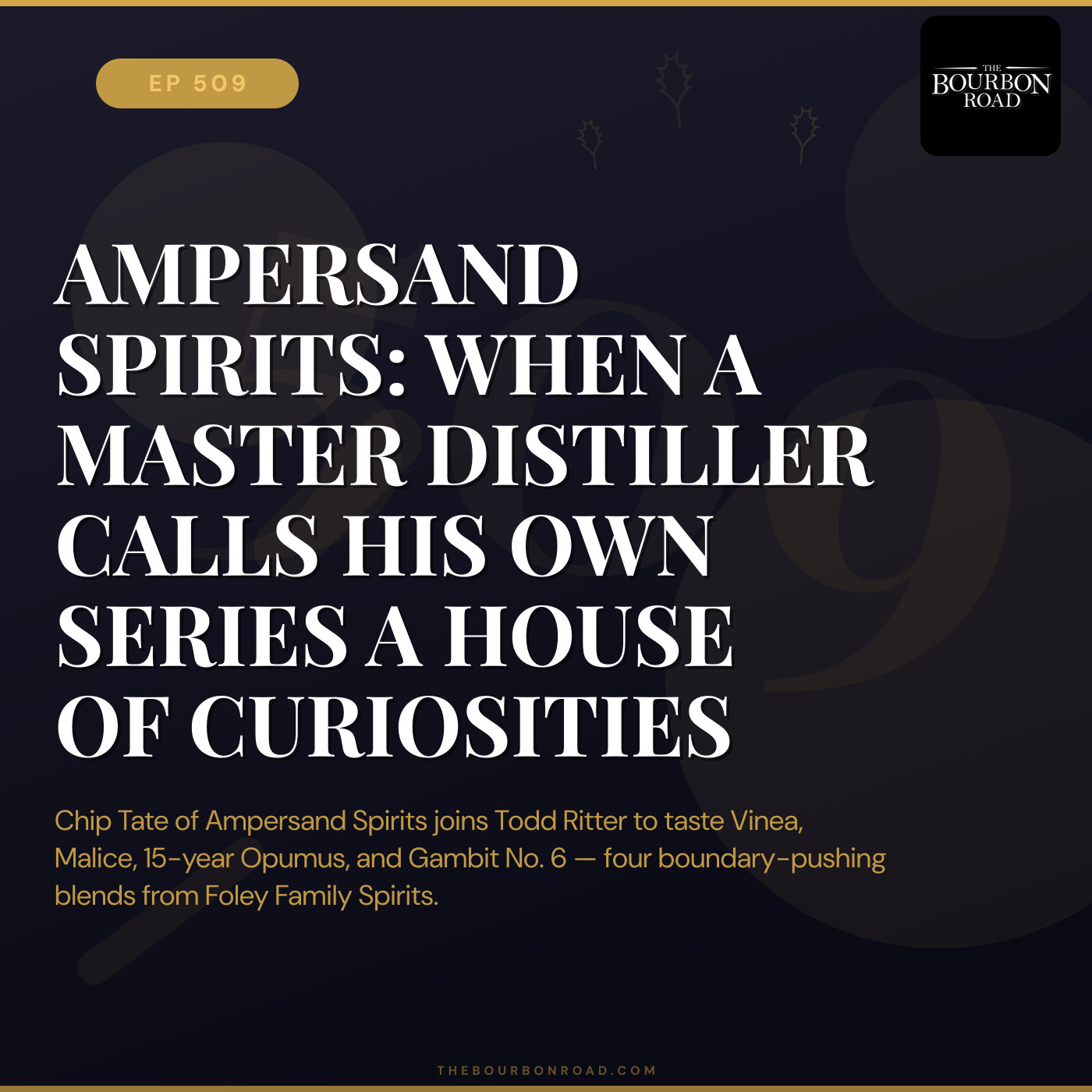
509. Ampersand Spirits: When a Master Distiller Calls His Own Series a House of Curiosities
Chip Tate of Ampersand Spirits joins Todd Ritter to taste Vinea, Malice, 15-year Opumus, and Gambit No. 6 — four boundary-pushing blends from Foley Family Spirits.

Reviews
Show Notes
Todd Ritter flies solo as host this week on The Bourbon Road, welcoming Chip Tate — Master Distiller of Innovation for Ampersand Spirits (a Foley Family Spirits project) — for a deep dive into one of the most inventive new whiskey series to hit shelves. Chip brings his decades of distilling philosophy, his background founding Balcones Distillery in Texas, and his stint crafting copper pot stills, all to bear on a four-expression lineup that challenges every assumption about what American whiskey can be. From a nine-year-old neutral grain spirit aged in ex-cognac barrels to a six-way wine barrel finish on a high-malt bourbon, every pour here tells a story of deliberate curiosity.
On the Tasting Mat:
- Ampersand Vinea: A 92-proof blend of 75% rye whiskey and 25% neutral grain spirit that spent over nine years in ex-cognac barrels — a happy accident born when barrels bought in France in 2015 for another project were kept wet and simply never emptied. The result is thin in body but surprisingly aromatic, with grapevine, cognac-cask fruit esters, and a firm French-oak tannin structure that recalls aged Scottish grain whiskey. Non-chill filtered. (00:01:28)
- Ampersand Malice: Also at 92 proof and non-chill filtered, Malice blends 51% rye whiskey with 49% Calvados (French apple brandy) into a cross-category spirit that Chip frames as a chef sourcing ingredients from two different farms. The nose erupts with apple-cinnamon potpourri; the palate delivers stewed apple, warming rye spice, and a richness that proves Calvados can stand toe-to-toe with a robust rye. MSRP $59.99. (00:13:07)
- Ampersand Opumus (Batch 1 — 116.6 proof): The crown jewel of the lineup, Opumus starts with 15-year-old Kentucky straight bourbon (sourced from Wild Turkey) that Chip found overly tannic on its own, then finishes it in Tokaji wine barrels for approximately one year per batch. At cask strength near 58.3% ABV, this is a dramatic whiskey: deep floral and juicy-fruit aromatics, stewed raisin, leather, tobacco, and a sweetness drawn from the mold-ripened Tokaji. Limited to roughly 55 barrels per release; when it's gone, it's gone. (00:30:35)
- Gambit No. 6: Bottled at 92 proof (46% ABV) and non-chill filtered, Gambit begins with a six-year-old high-malt bourbon that first passes through stripped-and-re-toasted Chardonnay barrels before being split into four finishing streams — Oloroso Sherry, Muscatel, Tokaji, and Laird's apple brandy barrels — where it rests for 18-plus months. The resulting blend is deliberately Bordeaux-like in concept: the Chardonnay provides structure and brightness, the Oloroso brings nuttiness, the Tokaji adds juiciness, and the apple brandy ties every fruit note together. Soft, integrated, and sessionable at its proof. MSRP approximately $65. (00:41:01)
Chip Tate is one of the most analytically minded distillers working in American craft spirits today, and this conversation makes that abundantly clear. Whether he's explaining why 46% ABV is the floor for non-chill filtration, drawing parallels between broken hollandaise and a misproofed blend, or describing how he shepherds hundreds of individual barrels through a six-way finish, his precision is matched only by his genuine love for the unexpected. Listeners who want to track down these bottles can find them through Southern Glazers distribution in most markets, or via direct-to-consumer options on the Ampersand and Gambit websites. A teaser for an upcoming fifth Ampersand release — described only as "a brother from another mother" to Opumus — should have fans of that expression paying close attention to Chip's Instagram at @ChipTateWhiskey.
Full Transcript
It's been a week of Mondays, but the weekend's here Dust on my boots and a smile with my beard Neons coming low, whether it knows our name Same old bar stools, but it never feels the same We raise a glass to the miles we've made To the stories told and the dues we've paid Amber light in a crystal glow A little burning Where the good times roll Passing bottles like a piece of soul Every pour's a memory, every sip a spark Lighting up the night in the Kentucky dirt Ain't no mail, just the ties we've sewn On the long winding bird
All right, listeners, welcome back to another episode of the Bourbon Road podcast. This is Todd Ritter tonight, and I'm flying solo, but not quite solo, because I've got Chip Tate, the master distiller of innovation for Ampersand Spirits. Chip, welcome to the show. Thanks. Appreciate that.
All right, man.
So before we kind of get into Ampersand's story and your story, we always like to dive into that first pour. So what are we sipping on?
Well, let's try some Venia first. This is a... You know, I guess we'll kind of talk about the series in general and in specific, but you could call Ampersand my fun little house of curiosities. So, unusual things done for different reasons. Not unusual in terms of how I feel like the spirit comes out, but just in terms of the story of how it came to be. So this particular one is definitely one of those really happenstance. I bought a bunch of cognac barrels that I intended to use in another distilling project that, well, it took years. In fact, it never even evolved to anything. So I brought those barrels back to the US, this was 2015, and it was 2015, yeah, 2015. And, you know, if you know barrels, you know that you've got to put something in them to keep them sound. You just leave them to dry out. They'll just fall apart even drier than they were before you fill them. So we put some neutral grain spirit in there in view of just keeping them in good condition. It was going to be six months or a year or something like that. And next thing you know, it'd been over nine years that I had. So I know you were curious to know, you know, how neutral this neutral spirit was. And the answer is, you know, not very neutral. Wow. It's crazy dark. Looks about as old as most things. And so 25% of Vinnia is that liquid. And if I can describe it, it's you know, thin in body, obviously, because it's a neutral spirit start. But it has all kinds of fruit and esters and extraction from the wood. It's kind of this interesting essence of cognac. And of course, it has a very strong tannin profile. So these are, you know, French casks. If you know French casks, if you've got something that's pretty well toasted, these were an old French wood and then you extracted hot fruit, you're going to get a lot of tannins. And it's so tannic that if you just drink it on its own, it kind of turns your tongue black. It's like, I feel thirsty. So I blended it with 75% rye whiskey, and that became Vineyard.
Now, is Vineyard just a word you came up with, or does it mean something?
Well, it just means, yeah.
I mean, it basically just means Vineyard.
Okay. You know, all of these names are kind of notional. They're kind of about something. You know, this is again about the menuous character of it from the cognac. Malice is kind of a play on words malice domestica is the Latin name of apples. That's right. Basically, half whiskey half apple brandy. And opumous means kind of ripe or juicy. And I felt like that was a great word to describe, you know, abundant, I guess you'd say. That was a great word to describe that whiskey, which we'll get to. But this is one that kind of has, it plays with you because it's light in certain ways, but it has a lot of character, I think, in others.
Yeah, I'm getting like almost like grapevine. And like you said, there's that cognac cask is very present. There's a little graininess to it as well.
Exactly. And it almost has, I mean, this isn't accurate because it's not Irish whiskey. But if you're a fan of Irish whiskey, it has certain kind of balance profile in terms of what bigger than you'd expect in some ways and sort of cleaner, lighter than you'd expect in others or at least compared to bourbon.
Right. And we should say this is 92 proof, correct? Yeah, 92. Well, I'm ready to take a sip. Cheers. Cheers. Clearing my palate here. I actually previewed these like Friday. I was like, I was so intrigued by these because yeah, actually what one of my first questions was like, you know, you think of neutral spirits and that you, you know, if you're any kind of bourbon person, you automatically start thinking of like, you know, the 70s where, you know, sales were down and they were kind of right.
So, And that's part of what's fun about this is, you know, you think of neutral grain like you're thinking of as this kind of almost ghetto thing when this is super bougie, right? I mean, like this is crazy. You never go out of your way on purpose to age it for nine years. But it is kind of an analog. If you like a broader set of whiskeys, you know, I got introduced to this years ago. To make blended Scotch whiskey, obviously you've got malt whiskey in there, but you also have grain whiskey, which isn't quite neutral grain, but it's close. It's pretty neutral. And the point is that when you taste those aged grain whiskies, I feel like it has a lot of similar characteristics, sort of really big and fruity on the nose and light and certain, you know, it's a totally different animal than you're gonna get from your traditional whiskey profile.
Yeah, that grapiness kind of still pops up on the pallet for sure. It's really soft. Yeah.
It definitely has this pallet hit that stays there, but it's also soft, like you said.
What were you saying? I was just going to say, why did you guys settle at 92 proof on this?
You know, 46% is generally considered to be the lowest proof at which you can not chill filter. I don't do chill filtration. because I feel like it strips a lot of flavor and aroma out of the whiskey. So anything that I do it, you know, low proof, I'll typically do it forty six percent in whiskey. Now, you know, in Agave, it's similar, you know, forty five, forty six, forty seven. But forty six is kind of the nominal rate. And I think you first saw that with a lot of the UK independent bottlers when they started doing a lot of nonchal filter. but now it's become a thing. So, but that's, you know, that's a fuzzy line because as we'll get to later, when you look at Gambit, it's non-chill filtered and it's a beautiful wisdom. But you know, if you hold it up to the light, you'll see, you know, it isn't quite as dead clear. Now, especially that's because you've got a lot of wine cask finishes. I won't get deep into the chemistry, but, um, that kind of haze has to do with estrus, and it has to do with tannins. And you're gonna get a lot of those, both of those categories from wine barrels.
Okay.
So I won't say that all wine barrel whiskey is more prone to chill haze, but like, kinda. So anyway, 46% is my bottom of the rung, you know, because we're not gonna go below.
Okay, let's go back to kind of your beginnings. You've been in the spirit spizz for a while, but what kind of led you there, I guess?
Well, I mean, I think my path really started far before I knew it in a way. So I got really into cooking, baking. when I was young, like, you know, 11, 12 years old and making sauces and just became a real fiend digging into how flavors were built and different methodology and the science of it and everything. So then when I was in college, it was exactly what point, but some somewhere in the neighborhood of 21, I started brewing. And in truth, I actually did some experimental brewing under the stairs when I was quite young. But, you know, this cooking turned into brewing. And then I was actually hoping to become a professional distiller, or sorry, brewer at one point, and then switched gears. So it was a personal delay, lots of different things happened. And during that time, I really became more of a beer drinker, excuse me, a whiskey drinker than a beer drinker, and decided to start Texas's first first whiskey with balconies. So that was my start. And then, you know, I left there in 2014 and did still making. Actually, I was building copper stills for myself, but also others, craft distillers. And then 2024 joined Foley to become their master stiller for innovation. So that's how these, this series, this is the first series that I watched with Foley.
Okay. And then where did the ampersand idea kind of come from? I mean, you know, the ampersand is the Roman symbol for and at all.
Yeah, to be honest, I mean, the concept was something that I cooked up when I was blending a lot of different things, starting with the malice and then the Venia opmus was a later add-on. But the name itself was my wife's. We were sitting around and knocking around ideas and she said, what about ampersand? I said, that sounds pretty good. It's really, it's two different things that don't always go together. And, you know, how different that is really just depends on the situation, but it's getting to a conventionally beautiful place in an unconventional way.
Very nice.
I can't get over how complex this is. Yeah. And I'm glad you picked up on that because I think a lot of people associate lighter whiskeys with not having complexity. And I hope to show that you can do a lot of complexity even here.
Right. Now, so I'm just curious, just out of curiosity, the what kind of how much flavor did the cognac impart on that neutral grain? I mean, was it pretty impressive or is are we getting that spice from more the rye?
I'd say the spice is more from the rye and also from the tannins from the cognac cast. So the juiciness of the cognac doesn't really come through in terms of the body of the spirits so much as you get those fruit aromas and the other nuances from age. These were exocognac barrels that I picked up myself when I was there in France and then imported. So I had a very particular profile in mind when I chose them. They weren't just your standard barrels, but it's funny what you end up getting from barrels and certain aspects of the spirit or the wine that was in them tend to really be emphasized over others. There'll be some parts that are almost entirely absent. And then, so the fruit, the body of the fruit will often not be there, but the aroma of the fruit and other sort of fermentation components will be there.
Shall we dive into the malice? Yeah, let's do it. All right. Sounds great. You want to tell the folks all about it? I said, do you want to tell the folks about it?
Oh, for sure. So malice is something that I cooked up, honestly, when I was blending a collection of different things at once. And I just had crazy idea to combine rye whiskey and malice and rye whiskey, rye whiskey, and Apple branding. The idea really was to make a cross category spirit because that's something that we don't normally do. And I say the reasons when you think about them are very historical. So the reason that people made great brandy or apple brandy or whatever. It really had to do with agriculture. So that is to say, people who grew apples did everything apple. You know, they make cider, they sell apples, they sell apple products, they do brandy. And as the distiller, I'm really more of the chef than the farmer. And so if I want to put, you know, mushrooms one farm together with bacon from another, why not? And the only answer why not, it's not usual. But it's delicious. And so that's kind of the idea across categories. You could say it's also kind of a fun play on barrel finishing, which I do, you know, like how much Apple brandy influences there was 49%. So pretty good amount as much as you can get without it being most of it. But I love the way that the rye and the apple brandy play together. And I feel like it's one of those unusual combinations that most people tend to get. They're just like, wow. That's a nice.
Yeah, I think Brandy is one of those finishes anyway that I really, really enjoy. You know, I was always kind of skeptical because, you know, I'm a Kentucky guy. So like the Brandy's I used to see back in the day were, you know, that E and J and Christian Brothers and stuff like that. So, yeah.
Well, that's and that's one of the things that I guess sometimes the spirits I'm making are a bit of a commentary on the industry, not a negative commentary, but just sort of like, you know, what about this too? What if we did this too? And so specifically, In this case, I feel like apple brandy has an important connection. And this is French apple brandy, you know, Calvados.
Right, Calvados, yeah.
Apple brandy as a category has a really strong connection to America and its history as well. You know, and so it is kind of this fun way of bringing back something ultra-American historically via France combined with something ultra-American with Rye Whiskey.
Right. A lot of people would argue it was our first, you know, probably the first beer made around here.
Yeah. Laird's distillery is the first DSP in the country and they're an apple brandy distillery.
So it's just proof of your point. This reminds me of like, you know, those like, like potpourri, but it's like all apple cinnamon.
Yeah. And there is an apple and spice. You see how the spice of the rye goes very naturally together with the apple.
And what was the percentage of plent on this?
I mean, it's 49% calvados. So it's basically 50-50. But technically, it's 51% rye.
Yeah, that's just delicious. Thanks. It's like applesauce, a little dash of cinnamon. Yeah. Funny thing is, I don't think there's as much rye spice on this one as the first one.
And it's because even though I think, you know, you're noticing there's like a conversation even between the spirits. Right. So this has Apples, you could argue, is kind of a lighter, fresher flavor in certain ways. But it's apple brandy. You know, this is that rich. It's such a rich spirit, is what I'm saying. I feel like calvados brings out the richest parts of the apple. And it actually ends up being as much of a heavy hitter as the rye whisk. You know, it stands up to the rye whisk, is really what I'm saying.
I think my biggest misconception about Brandy was I always thought it was sweet. And then as I learned more, I found out, well, it's just kind of like Cognac's cousin kind of.
Well, that's true. And another thing that I mean, everybody has their own rules for their own reasons. I'm a little bit of a purist myself in terms of like, if you're going to add something other than water. So we all kind of understand that if it's some proof, it's not cast proof. that people have added water. That's kind of implied in understanding how spirits work. But if you added anything else, I want to know. I want to know what it is that you've added. But that said, it is traditional to add up to 2% sugar to a lot of French brandies. That's allowed in their regulations. And so it is Particularly the case the younger rougher brandies will have a higher sugar addition to try to mask that and so all that together kind of gives you this like Huh, you know like it's it it's not on the same par with a with a well-aged bourbon for instance But conversely if you're looking at really similarly aged and similar quality brandies, none of that's true You know, right the sugar addition is optional but not necessary and this is you know, seven plus year old spirit. So it is, you can always kind of argue where the right amount is. I feel like with brandies, and especially for me with Apple brandies, as much as I really appreciate the super old stuff, I want it when it's juicy. You know, I want it when it's that kind of like six to 10 year old stage is often some of my favorite, maybe 12. you get a lot more complexity with age of course you get a lot more tannin but you there's a ripe sort of fat juiciness that you get in that relatively young calvados that i really appreciate and you see it here in malice now with the vinea being such a you know i guess like a
glorious mistake, kind of, like you kind of forgot about the brailles and, you know, threw that in there just to kind of keep them wet. I mean, is that something that's going to be, is that going to make it limited? Or, I mean, are you going to?
There's only a certain amount of this. There's only a certain amount of this particular one. And, you know, we decided to include some of those. That's always a hard choice as a maker. You know, do you do something that you know you can't do again?
Right.
I think the answer is like under the right conditions. Sure. Why not? I mean, if you've got 30 cases of it, that's kind of messy. I've tried sharing really small amounts of spirits before and it was messy.
I did not get it right.
You know, we had maybe a thousand cases, something like that, which is not a lot, but it's enough to put it out there and let people try it. So, unfortunately, this will not be forever. Malice is something we can continue to produce and plant. And we haven't gotten to the optimus yet, but it won't surprise you to know that the liquid that's made from that particular 15-year-old, there's a limited amount of that. When it's gone, it's gone. But that's pretty normal, I think, for a lot of older Bourbons, people understand.
Yeah, for sure. Now, what's the MSRP on these two? I believe these are running about $59 on these first two. $59, that's a great price.
Yeah. Yeah, I mean, they're, I feel like, very, very affordable for the quality, for the character, and not just for the novelty factor. You know, these are, One of my best measures is I have friends over to the house and I simply look at which bottles I need to replace the most. And these two bottles I need to replace a lot. So that tells me that there's somebody that wants to mess with them. Not that the others aren't, but these are both delicious and they're easy drinkers.
I mean, if you gave this to someone blind, they would almost think it. I mean, if they have any kind of decent palette of knowledge, they might say it's brandy finish. I don't know.
Right. And it kind of does put you on your toes. You're like, yeah, wait, so fruity. Like, you know, it's intentionally kind of confusing. But that's that's the idea is to kind of have a conversation that's unusual between brandy and whiskey. And You know, does this broach the line between spirits and cocktail? Like, not really. What is that line? You know, honestly, an arbitrary line that we draw when we put it in the bottle. But it's a conversation that's fluid. From the moment you conceive something to the moment you pour it in a glass. There's a lot of different ways you can take it.
And I think at this price, this is like, you know, it looks great and we'll get to the bottle. Maybe probably the second half, but I'm like, this is like you said, this is something, you know, we're sitting here drinking it neat, but you could also pour a rock in it and soften it up even a little more. And then like you said, you know, I think one of the things you really guys really highlight in your website is some of the great cocktails these two spirits are made.
Yeah, I mean, there are a lot of different things to make great cocktails, but I think, These are kind of extra fun in the sense that they add elements you don't normally have at your disposal, you know, I'm, I'm a pretty lazy mixologist. So I don't do that much, but I work with some great mixologist and some of the comments that they give me are just that it inspires them to kind of go in different directions. They're very parallel, but like, you know, using malice in an old fashioned is actually really good. Or just on rocks or any number of kind of conventional cocktails that you would try with different whiskeys. This makes an interesting take.
So what kind of drew you to this Foley family project kind of thing?
Yeah. Well, honestly, I had the pleasure of meeting my now boss, Sean Schiffer, and he sold me on Foley's plan to develop spirits. Obviously, they've traditionally been a wine company. You know, the brief backstory, Bill Foley is a famous financier, billionaire who's done many different things, but in the alcohol zone, it was mostly than one. And they've done a few things here and there in spirits, but not as a primary focus. So I came on to help them develop that portfolio and to bring some of my Particular gifts, I guess you'd say, to the mix. We already had a great and do have a great team at Menden Mill. That's one of our brands. And we've got a handful of other things. Obviously, Lighthouse Gin and a lot of great partners that we don't produce, but we distribute. Alamahicana Tequila and so forth. So it's me and a handful of other folks trying to create a great collection for Foley.
Yeah, we had the luxury of having Joe on from Minnen Mill not too long ago. Again, very impressive spirits. Yeah, great guy. Right, that whole Rick House and the airport controlled temperature thing, it's like, it's got to cost a fortune to be in Nevada and do that.
It is not a system that was designed by somebody on a budget. You know, I worked with originally Bentley Heritage and I don't know, but I've been told that Chris Bentley He's not a poor man. So he wanted it how he wanted it and good on him. You know, it was it is a really beautiful setup and it gives us some some wonderful luxury. So, for instance, we have one warehouse that's Kentucky conditions.
Right.
And another essentially Scottish Highland conditions. And for a lot of the stuff that I'm doing, the Scottish warehouse is perfect in terms of extracting.
Oh, yeah, for sure.
And these wine finishes.
So do you foresee maybe using some of that Mindenmil whisky for things at some point?
I don't know that I'll be using the Mindenmil whisky. That's pretty much focused around the Mindenmil brand. There could be a time. when I do a project at Minden Mill and get to use those beautiful stills. It's a long thing to plan out because of the way that the estate works. They essentially have to either grow or contract for grain or whatever material it is. So there's a long timeframe, but who knows, someday maybe.
It'll be great. Yeah. All right. Well, how about we take a short break and we'll come back and we've got two more spirits. So you guys sit tight and we'll be right back.
We argue notes, vanilla or smoke, but it's all just part of the bond we spoke.
All right, Roadies, we finally, finally released our brand new website. We hope you get a chance to check it out at TheBurbanRoad.com. It is a total rewrite, remake, revamped. We've done it for you. We have all 500 or so episodes on there with all the details searchable. All you know all the show notes everything you can search by it You want to go find out what we talked about on an episode way back when you can do it We've also got our tasting notes our reviews of over 1,320 whiskies. They're all on there Todd and I's our tasting notes our rating for the whiskey We even cue up the episode on the tasting notes To where we tasted on the show. So as you're reading our tasting notes, you can play it listen to us talk about it So I think we're the only podcast that does that that's pretty cool So another thing we have on there is our blog articles. We've got over 250 blog articles on there. We're putting new ones out all the time. And the all new Roadie Bar is now on the Bourbon Road website. So if you're a Roadie, come on, sign up, get in there. We have a chat room. We've got a place where you can post what's going on in your Bourbon world. We have a calendar of all the events that are coming up. We'll be posting in there our, drawings, so as we're giving things away, you'll be able to come in there and sign up for the randomizer to get picked. You'll also be able to sign up on lists to come to something that we're sponsoring. Todd's got a great event that we're putting on in the fall, and everybody can come in and sign up for that. And we've also got coupons from our vendors for percentages off on stuff. Definitely take the time to come to the website. Check it out. We do want you to come in and sign up and join in. It's a lot of fun. It's free. It doesn't cost you anything. You're certainly welcome to donate if you want to, but it's free for all roadies. So come check it out.
Alright listeners, welcome back to the second half of the show. I'm sitting here with Chip Tate, the master distiller for innovation at Ampersand Spirits. We first tried the Vinea. which was a blend of rye and neutral grain spirits. Quite impressive. I was a little skeptical. I popped this open Friday, and I was like, that's kind of scary. You just think about that. But very impressive stuff. And then we follow that up with the malice. And it's a blend of 75, no, sorry, 51 rye and 49 calvados. Apple brandy. Yeah. These are both at 92 proof and MSRP at 59.99 and excellent. And I think we're ready for our third pour. And I'm gonna give us somebody a shout out real quick because your PR person did not have this bottle. So, you know, I have friends in high and low places. So someone sent me a sample of this by good buddy, John Legalbo. He's in, I believe he's out in, I think he's in, He might be in Texas as well. So shout out to John.
Yeah, this one is pretty popular. And so there are still bottles to be had. But apparently, however fast they're flowing through the system is not always the right speed because it's going to be hard to get.
Right. So tell the folks about this one.
All right. So Optimus, I was lucky enough to inherit Some 15-year-old barrels from Wild Turkey. You know, I got a hold of the spirit and I really enjoyed it. But especially in view of this series, I was kind of like, well, as much as it is good as it is, I feel like it had a lot more tannin. You know, this is kind of similar, actually, to the Vinnia, that it had a lot more tannin in there than it had body. And so I needed to blend that out with something else. And so in the case of opumus, it's just pure 15 year old wild turkey. I'm not supposed to say that. Sorry, but it is.
If you know, you know, kind of things there. I mean, yeah.
Okay. Yeah. So I just kind of dropped it out there. It's such an open secret that I, you know, anyway. And then finished in Tokai barrels. So I don't know if you know Tokai. It's probably most similar to like Saturn, but I like them at least as much. It's a mold ripened white wine. So you get these really rich, deep, juicy fruit notes and some sweetness. And I felt like that would be the perfect compliment to the, to the whiskey and especially balance out. I was getting, these were barrels. I think a lot of them had been stored rather high. And so there was a whole lot of extraction. and getting kind of chewy, as they say. So I want to encounter that chewiness with some roundness and some fruit.
If these are related to the 15 year old single barrels, I actually got to pick a 15 year old single barrel from an unknown source, you know, quotation marks. Yeah, some of those were very, some of those were very rough. But I mean, we did find a gem, you know, kind of thing. Yeah. And that's
You know, that's one of the challenges, I feel like, this is true with all spirits, but I think you could say particularly urban, because you're always gonna be in a new chardon container. And when you've got that going on, there's the potential to extract a whole lot of wood, maybe more than you want. Wood, I kind of think, especially tannin, I think of it as like salt on meat. It's a great thing and it adds a lot, but you can't get too much of a good thing. So you're always basically as someone mining spirits, trying to make sure that you don't over oak it before it's mature as you want it to be. And so this was a way to sort of bring some of that chewiness down a little bit, or at least meld it together with some other big flavors and make it work compositionally.
Yeah. This may have one of the best noses I've smelled all year. It's just, it smells rich. There's like some, it's like floral qualities to it to me.
Yeah, sort of floral.
Floral and juicy, like you said, the juicy thing is there, like almost like juicy fruit gum.
And the tobacco is there at the same time. And that light dryness that I feel like compliments the sweetness really well, but it's not overwhelming. So this one's, stronger. Yeah, I was going to say this is that 117 proof, I think.
So, there have been one, two,
three bottlings there have been more bottlings anyway three blends gotcha this is the sorry one one 16.6 proof is the one we have so that's the first one okay so that's that's the only way you can know them honestly is by the proof and you know one of the interesting things about it they're very very similar But obviously, the first one happened before the second one, before the third one, et cetera. So you see some difference in time. It's probably not more than four or five months. Three to four months will say different. See, we did the first one about a year ago. It's a bit more than that. But the evolution of the Tokai finish. So the first is at 58.3. The second is at 58.0. And the third is at 57.9. That's just, you know, for the geeks, those are very tight in terms of proof, but in terms of knowing the order in which they were bottled and therefore kind of which spent the least next longest and longest amount of time in Tokai.
So about what was about the average on those Tokai finishes?
I mean, they're about 58, right? They're all, you know, the... No, no, I'm sorry.
About how long were they in the Tokai barrels? About on average? Oh, right.
I knew you were going to ask me that. Let's think. Oh, sorry. About a year. I think the first were in there about a year. And now it's about two years. Let's see if I got that right.
And this is that one, like you said, you kept this at a higher proof. and is rather than drop it to 92 for like you did the other. So did you just like it as is and you didn't want to spoil it?
I like it at the stronger proof, but also this is $149 bottle. Right. And so, you know, price is connected to proof. The water is in fact cheaper than the booze. So I would say for higher price stuff, you really have all the options on the table. And I also think For most older whiskeys, it's better to put it out at higher proof. You know, some can be too high, but to give people a chance to taste it kind of in its original glory, because it will expand the whisky a lot. And there's nothing wrong with adding water, but I'm just saying that if I give it to you at this proof, that's the highest proof that you'll ever taste it at. And you can always, you know, take license to add ice or water or whatever, but you can't take it the other direction. So it's more sort of the luxury, you know, this one has shades. But I do feel that it's really drinkable and integrated and dense at this proof.
Oh, it's delicious. I love it. It's got like this. stewed raisins. Yeah, that leather is just sneaking around there. Mm hmm. Yeah, I love this. Oh, John, a big kiss for this.
Yeah, I'm glad. And as always, I can't, you know, there will be a point in the not too distant future when we can't get bottles. But in the meantime, you know, let me know where we can't get bottles and I do what I can. The distributors tend to see them fly out really quickly. And so we're trying to pull back some. I'm like, well, that's good. As long as we don't hold back so much, people can't get it, which is kind of the point. So we're always trying to figure out where there are pinch points and then try to help people out.
I could sit and sit. This might have been the nightcap, I'm going to say, because I just want to sit and savor this for a while. Yeah.
Yeah, that is that is the hard thing is because if I were just doing a tasting outside of the series, Gambit would probably be the next dense. And, you know, that's a wonderful whiskey. But it's it's a sixty five dollar whiskey, forty six proof. It's not a six year old. You know, it's just a different animal than a 15 year old.
I like that you're still allowing some of those like the best parts of that bourbon to kind of shine through.
And that's, I'm glad you called that out because that's really what I was going for. I think some of the, I will say the concern of certain people who might be worried about cast finishes is, you know, that you're covering up what's beautiful about the original bourbon. And what I really try to do is try to compliment it and in certain ways, even highlight it. You know, so there's certain aspects with it. I feel like the spice comes out in this and it plays along with the sweetness and the juiciness rather than one covering up the other.
Alright, before we jump into the. to the Gambit and be sure to give this a really long answer so I can sip on this some more. Oh yeah, should definitely. So tell me about this bottle. I mean, is this something you guys came up with or is it like you guys have one of the wackiest bottle brokers out there in the world and he's like, check this out.
So we've got to give credit to, we work with a lot of great marketing people and designers. Anne Gustafson is our designer on this and she, There was a more elaborate bottle that we worked on together, mostly her, to give you the bottle that you see now. So, you know, it's a challenge for the team to design it now because there aren't as many flat places, but I think it's really cool. I'm sure everybody's seen it, but the facets, you know, the facets in the bottle, it's kind of jewel-like. And it's the Cantor style. And I think they did a nice job with it.
Yeah. I mean, definitely, like, if you're walking past a shelf, it's going to be like, hey, that looks different, you know?
Yeah, you'll notice it. And I'll mention, too, I'm not supposed to go into it. I'm teasing this out a little bit. But there is another coming in the series. And if you're an Optimus fan, you'll want to check this next one out. Oh, you heard it here, folks. They are brothers from another mother.
Mm. Well, hopefully our PR person maybe sends us a sample of that to review or something. We'll see what we can figure out. Yeah, we'll have to figure that out.
Awesome.
Awesome. There's more and more. All right. As much as I hate to leave this opumous, we've got to move on. And not to say this, like I said, I tried all of these and yeah, this is a treat too.
Yeah, I mean, so I'll talk a little bit more about Gambit, but just in terms of the differences, you know, this is, this is a session whiskey. I mean, this is a, this is a great, this is the whiskey analog to a great red wine at the dinner table. complex, nuanced, has as much to find in there as you want to find. And also just pleasant and drinkable and structured and a nice compliment to a lot of other things. So Gambit was really an early project in terms of conception at Foley. It just recently came out because it took us about two years or took me about two years to get through the whole process of what I wanted to do. But it started as a complex maneuver into wine barrel finish, I guess you could say. I was combining different wine barrel finishes to try to bring a, I guess you would say this is an analog. A Bordeaux wine is made up from up to six grapes. And there is a profile that we all associate with that region that isn't associated with any one grape. And there's a very similar structure to gambit in terms of some of those components play really big pieces. And then others are nuances and tweaks and add, you know, very delicate components to the way the whole thing comes together. Um, but just to kind of talk about what it is, it's a six year old, uh, high malt bourbon and six years old as in that's, we started with six year old. It's, it's been aged more and barrel since then, but as you know, they don't count those years for bourbon. So then some of it goes straight into some Cabernet Sauvignon barrels and lives there for the duration. It's about less than 20%. And the other portion goes first and do some stripped and re-toasted Chardonnay barrels. Now there's a little bit of the Chardonnay character that remains, but mostly what you get from that is the structure of wine barrel. That is to say the vanillins, the lactones, the other things that you bring out, that are more particular to French oak and also more particular to toasted. So you could say, I'm not saying that is the prototypical wine barrel, but it's certainly a different barrel than a charred American oak barrel, which is arguably the prototypical bourbon barrel. So it's this kind of counterpoint. But all the liquid that comes out of there then gets split to be aged in four different types of barrels. Oloroso, Muscatel, Tokai, and Laird's apple brandy, which I will brand is not a wine barrel, but it's fruity. So Whatever it works and and to me it's not just that it works It is a key component in tying together these different fruit qualities Because, you know, one of the things anybody would worry about on a six way bet is this is six different ways to be wrong. Like, you know, there's a possibility that five would have been great, but six is where it all fell apart. You got to really look at that. So, but I had a very, um, particular notion of what I wanted. Again, an analog to a Bordeaux structure that I built and had to change my, my strategy throughout. So, you know, it's spent a good 18 plus months, years in second or years, sorry, months in secondary Oak. And, um, It's a notably different effect. I feel like, you know, you're really more into like secondary aging. It's not technically that. But what I mean by that is if you just finish something for a couple months, you definitely get the influence of the liquid that was on the surface of the barrel, which is great. But when you go over a year, you're getting deep down in there and you're starting to pull a whole different set of components and characteristics from those barrels. It's a much deeper and more nuanced finishing process that starts to reshape the whiskey. So anyway, 46% and six different barrel finishes.
So you finished these like all about the same? I was kind of that was my question. Like, I mean, how did you I mean, it's just kind of mind blowing to like what you did here, because I feel like, you know, if you went a little too long with something, it might dominate the blend. I mean, I feel like you, I feel like you were like checking them like, you know, like every week or something.
Not every week, not every week. I mean, you do learn, but you're exactly right that you have a pretty good idea of how long this is going to take, but you check. You check not only individual barrels, but a lot of barrels. Are there some that are starting to get way too something in the mix that you need to catch? Or are they all relatively homogeneous? Or, you know, you'll find all these different patterns that happen with different barrels. So perfect example. For me, these Cabernet barrels, and they're really nice Cabernet barrels, but it's Cabernet that has a strong malolactic component in it. And it's kind of that fully cultured butter. It's almost like not sour butter, but that sort of piquant butter. What I find with those type of barrels is it'll kind of get to this certain stage and almost stay there for months. And then all of a sudden it'll sort of pop over the edge. And that's when the fruit and these other components come in. And you have to just be waiting there and checking. You know, there's a lot of shepherding that goes into this. That's the hardest part of gambit is not the conception. It's the execution. Because every time I blend this and re-blend this, I'm tasting, you know, at least 400 barrels of different things. to not only decide which should go into the blend, but which barrels stay as they are. Do they need to go somewhere else? You know, this is a general evaluation of where we're going and how it's shaping and what we might need to change.
What do you think? Well, coming off that opomis, it's a little light on the nose, you know, but that opomis, that's such a monster of a nose, it's not surprising. Yeah.
nearly 10 years difference, but more particularly the proof. One thing I wish we could do, and we may be able to do in time, is I've got a bottle of what you're tasting, but at 59%. And it's not the same, but what I would say is if you taste the cast-drink version of this, you're like, okay, wow. Actually, that's a big, beautiful whiskey. It works really well at different proofs. Part of why I brought this down in proof is because price point. Honestly, I didn't want it to be over, you know, 100. But the other part of it is there's a real softness and integration. This is the whiskey that will break down if you proof it. You know, a lot of complex brandy blends are this way, too, that once you get to a certain point, you really need to proof them down slowly. And if you don't, the whiskey will kind of break. And what I mean by that is it's like you get this flavor and then that flavor and then that flavor. It's almost like a hollandaise that is broken. You know, you still have lemon in there and you still have butter in there, but they're all kind of in different bits and pieces. And there's a very similar chemical thing that's going on in terms of emulsified things that are barely in solution that want to be in this high ethanolic solution. So we bring it down to like 50 something and then have to go slow, slow, slow, slow to make, you know, over a month to make sure that the proofing is the way we want it.
Right. So the more notes that I can, I don't know if like it's like each barrel is kind of coming out. I get like a little bit of the apple and then I get a little minerality maybe from that Chardonnay. Right. And then maybe a little nuttiness from the Sherry.
It's very nuanced and it's one of those that like if you, you can take it apart a lot better at this proof than at higher proof. and in that way it's more nuanced of course the other is this sort of big like it's like this huge chord as you bring it down you get to hear the different notes play um all right well i'm gonna take a sip now cheers all right oh that's like a fruit medley it's like all the berries, like there's a little bit of like- I don't want to say this is essence of wine because what does that even mean? Right. But it does have characteristics of all these different wines that I've tied together in different ways. The brightness of the Chardonnay, the richness of the Oloroso and the nuttiness, the juiciness of the Drakai, the light butter characteristic on the Cabernet, and apple brandy to tie it all together. Yeah, that's wow. It is kind of an intentionally constructed chord. And I think that's what people need to understand, too. It's like any musical performance. Of course, you can screw it up. But if you understand how chords work, you kind of know which notes are going to work together.
Right, right. They got rules for that. So I've got to ask, you know, um, why, you know, the ampersand is under one website or as the gambit number six kind of flat solo.
It's its own brand. Okay. Um, not that I disagree. I guess the simple answer to your question is marketing. They're different concepts really. And also like Gambit is a larger brand. Not that it's going to happen, but if the world wanted 5,000 cases of this tomorrow, I can do that. Like I've bought some stock. The ampersand is my little house of curiosities. And it's not always so little, but a lot of it is like, like the next, you know, the ampersand opmus is a 55 barrel series. And so that's a good amount of whiskey, but it's not a whole lot of whiskey. especially for the whole world and you know the next release that I'm not supposed to talk about but like it's even slightly smaller it's meant to be the house where I find these interesting projects and it might even be inherently limited and that's kind of the Ambersand series.
Okay. Can we expect to see maybe gambit number seven, eight, nine, get some point or variations on number six?
I think I shouldn't push my luck on number of barrels. I mean, it's possible, but what I'm probably more interested in is either kind of focusing on different aspects of the series, maybe a cast strength. I mean, honestly, I really want people to try the cast strength because I feel like it, you understand so much more about the whiskey when you try it both ways. And there are some whiskeys that are kind of just what you'd think as you go up and down in proof, and there are others that's revelatory. You know, like just, Obamas is one of those that it changes dramatically in terms of what you get at different proofs. Gambit is also definitely one of those in terms of which barrels play out the most and whether the base comes through the most or the treble comes through the most. So maybe we'll do focus on different sort of barrel finishes there. But, you know, for now, I'm just trying to keep the main game at number six standard, really good, high quality, and then maybe look at our other cast right now.
I was going to say I did a little diving into Foley Family Spirits and like, like you said, they've got their fingers in a lot of pots now. So I feel like, you know, you could be the definitely the benefactor from that because you know, they've got Irish whiskey. They've got scotch. Yeah. So I mean, you gotta be like, this is a playground for me kind of thing, you know.
You know, I wish everyone would let me use their toys, but whether they will or not, it's a great set of toys. I mean, two stacks of amazing stuff. I love those guys. Loch Lomond has an amazing portfolio of spirits. And obviously, Loch Lomond, these are part of those. But it's also Lynn Scotia and a number of, you know, they've just got not only a great quality of whiskey, but a huge diversity of different options out there.
So yeah, we tried the two stacks too.
Yeah. that I'm super fascinated with. I feel like I don't want to speak for other whiskey drinkers. It's easy to have a kind of narrow conception of what Irish whiskey is.
Agreed. And they're pushing the boundary.
They're pushing the boundaries. And also Kill Owen is another distillery that we work with. And they're doing amazing things as well. So yeah, it's great to have good whiskey buddies.
Right, right. Well, we want to give you a chance to tell the folks where they can find you and where they can find these products and things like that.
Yeah, so I'm at Chip Tate Whiskey on Instagram and pretty easy to find in the same way on Facebook, other things like that. But y'all should be able to find these things around. It's distributed through Southern Blazers, except in states where Southern Blazers doesn't work or control states. But my point is it should be generally available. And if it's not, shoot me a message and let me know where you're having trouble. see what we can do because we're definitely trying to connect people with bottles.
Right.
Now, any online type things?
Let's see. I don't really have much outside of Instagram.
We've got... No, I'm sorry. Any places they can order online.
Oh, yes. I'm sorry. So all of the websites have a direct to consumer option. I mentioned, you know, a number and grand note to my Mezcal and tequila respectively are just launching so they don't have a DTC option, you know, that's still kind of unfolding but Gambit and Nebersand and all of that, they do have a DTC option. I know Optimus is always one of those things you've got to check availability. Right. And so I don't want to say that it's available online right now. It has been. I don't know if it is at this moment. But if it isn't, it should be very soon, because I've still got some bottles coming out. So the point is, if you can't get it right now, give us a second, and we'll get those bottles out. Because we're going to be out pretty soon, but we are not out yet. I'm trying to make sure of that.
Awesome.
Well, hey, it's been a pleasure.
Yeah, man. It's been great. I've heard lots about you and, you know, we talked about another project that you're kind of involved with that some Kentucky guys here. So that's you're doing some great work here. And I'm very excited to see what you what you do in the future, because you are definitely pushing the boundary, man.
I'm trying to do some good stuff. I hope people like it. And I appreciate your support and appreciate you having me on.
No problem. All right. So you can find the Bourbon Road on all kinds of social media type things like the X and Facebook. We've got a big roadie group. But the place we're trying to get folks to go and check out is our website, the bourbonroad.com. That's where we have, you can check out all our 500 episodes and you can like do a quick dive and type in Chip Tate's number and that episode's gonna come up and you can literally listen to it immediately. You can find, you can type in Malice, M-A-L-A-U-S and it'll literally bring up the clip where we talk about that. My buddy did the website and it's quite amazing. Nice, that's great. Sometimes we get someone like Chip Tate on here to talk about his new product. Sometimes we sit around and just taste some whiskey and talk about it. But the one thing we always do is have a lot of fun. So one other thing you can do that helps us on down the road is you can go to your podcast platform and subscribe to us and leave us a review. But until the next time, we'll see you down the bourbon road.
Where the good times roll Passing bottles like a piece of soul Every pore's a memory, every sip a spark Lighten up the night in the Kentucky dark Yeah, we laugh too loud, let the worries go Find a little truth in the afterglow Ain't no man, just a ties-leaf song On the long winding bourbon Here's to the nights that turned into dawn To the friends who stayed when the rest moved on To the clink of glass and the stories spun And the quiet peace when the night is done On a bourbon road we ain't alone Every mile's marked by the love we've known From barrel to bottle to the hearts we hold there's a fire that never gets old so pour it up let the moment slow a little bit of life in every glow yeah forever we'll call this home on the long winding
The Conversation